
Powdered Activated Carbon (PAC): High-Performance Adsorption for Water and Industrial Purification
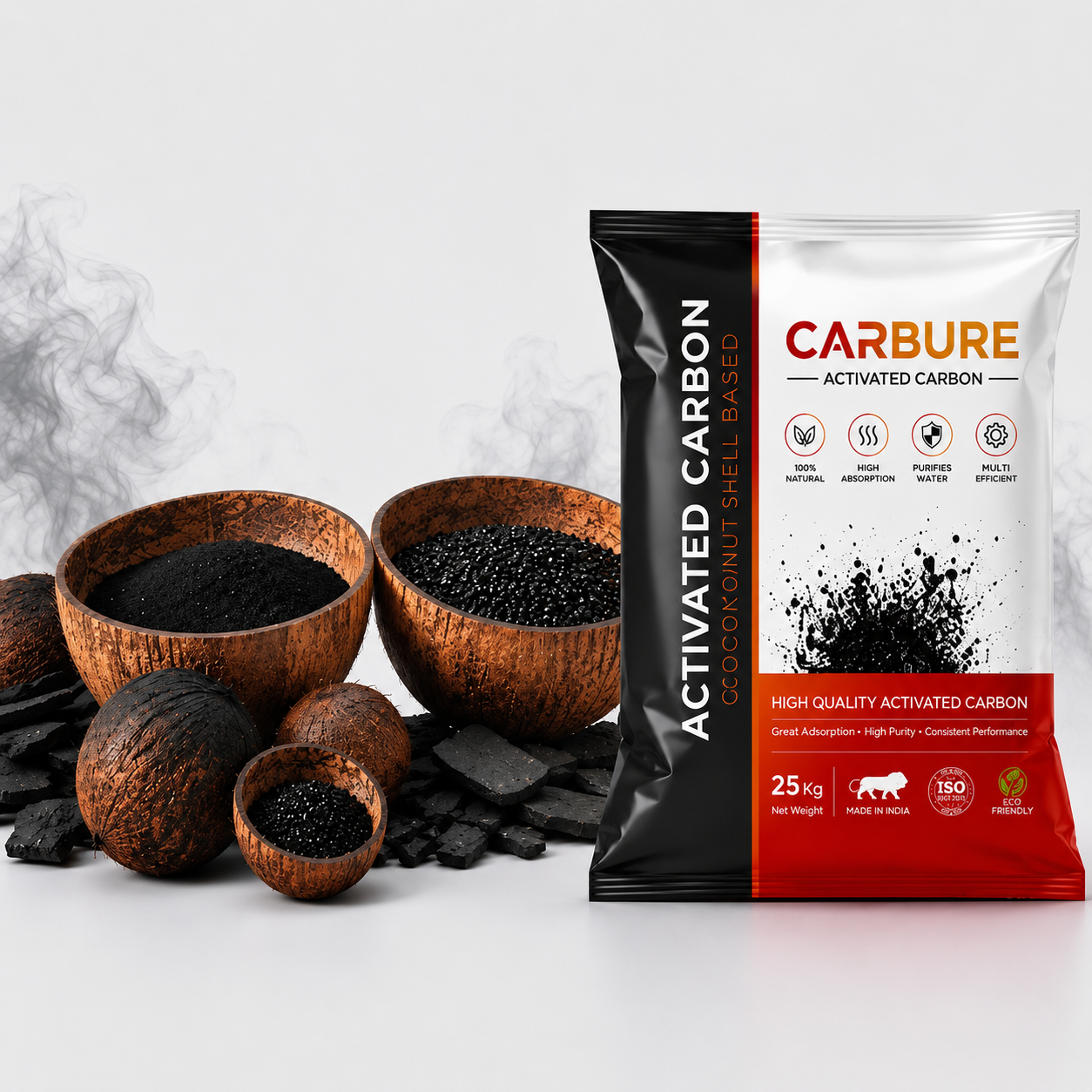
Powdered Activated Carbon (PAC), Steam Activated Carbon, Coconut Shell Activated Carbon, Industrial Purification Carbon.
Powdered Activated Carbon (PAC) is a finely ground form of Activated Carbon widely used for rapid contaminant removal, decolorization, purification, and odor control. Its fine particle size provides a large external surface area and enables quick contact with contaminants in liquids and process streams.
Carbure Activated Carbon manufactures high-quality Powdered Activated Carbon from premium Coconut Charcoal using advanced steam activation technology. During activation, Coconut Charcoal faces superheated steam at 1000°C, developing a highly porous structure with excellent adsorption capacity.
The fine particle structure of Powdered Activated Carbon (PAC) allows it to disperse rapidly throughout liquids, improving contact between the carbon surface and dissolved contaminants.
Powdered Activated Carbon is commonly used to remove color, odor, taste contaminants, chlorine, organic compounds, pesticides, VOCs, dissolved impurities, and process contaminants from water and industrial liquids.
It is extensively used in drinking water treatment, wastewater treatment, food and beverage purification, pharmaceutical processing, chemical manufacturing, edible oil refining, sugar decolorization, and industrial effluent treatment.
As a reliable manufacturer of Steam Activated Carbon, Carbure Activated Carbon supplies consistent Powdered Activated Carbon grades with controlled particle size, adsorption efficiency, purity, and dependable global supply capability.
Why Use Powdered Activated Carbon (PAC)?

Powdered Activated Carbon offers rapid adsorption performance because its fine particle size creates extensive contact with contaminants. It is suitable for treatment systems where activated carbon is added directly to water, wastewater, process liquids, or chemical streams.
The carbon can be introduced through dry dosing or slurry dosing systems and mixed thoroughly with the liquid. During contact, contaminants are adsorbed onto the internal and external pore surfaces of the carbon before the spent carbon is separated through sedimentation, clarification, or filtration.
Powdered Activated Carbon (PAC) is particularly effective for seasonal contaminant control, emergency treatment, temporary pollution events, taste and odor problems, color removal, and process purification applications.
Its flexible dosing capability allows treatment plants and industrial facilities to adjust the carbon dosage based on contaminant concentration, flow rate, contact time, and required purification performance.
- Rapid adsorption due to fine particle size
- Effective removal of color, odor, taste, and organic impurities
- Flexible dosing based on treatment requirements
- Suitable for batch and continuous treatment systems
- Supports water, wastewater, food, pharmaceutical, and chemical purification
- Effective for seasonal and emergency contaminant control
Why Choose Coconut Shell Based Powdered Activated Carbon?
Steam Activated Carbon derived from Coconut Charcoal offers high adsorption capacity, excellent microporosity, low ash content, and consistent purification performance. These characteristics make it a reliable raw material for manufacturing high-quality Powdered Activated Carbon (PAC).
The pore structure developed during steam activation allows the carbon to adsorb dissolved organic compounds, color molecules, odor-causing substances, pesticides, chlorine by-products, and other impurities from liquid streams.
Compared with many conventional carbon sources, Coconut Charcoal provides superior hardness and lower mineral content. When processed into powder, it delivers efficient contaminant contact while maintaining consistent product quality and adsorption performance.
As a renewable raw material, Coconut Charcoal also supports responsible manufacturing and resource utilization while providing dependable performance across demanding industrial purification applications.
How Powdered Activated Carbon Works
Powdered Activated Carbon works primarily through adsorption. When PAC is introduced into water or another liquid, dissolved contaminants move toward the highly porous carbon surface and become retained within its pore structure.
The fine particle size helps the carbon disperse rapidly, creating extensive contact between the adsorbent and the contaminated liquid. This can improve adsorption speed and make PAC effective where shorter contact times are required.
After the required contact period, the used carbon and adsorbed impurities are separated through clarification, sedimentation, filtration, or other solid-liquid separation processes.
The required PAC dosage depends on several operating factors, including contaminant type, contaminant concentration, particle size, contact time, water chemistry, pH, temperature, and the desired treatment objective.
Industrial Applications of Powdered Activated Carbon
Powdered Activated Carbon (PAC) is used across industries requiring rapid adsorption, flexible dosing, decolorization, odor control, or removal of dissolved organic contaminants.
In drinking water treatment, PAC helps control taste, odor, pesticides, algal by-products, dissolved organics, and temporary contaminant events. In wastewater treatment, it supports the removal of color, chemical residues, refractory organic compounds, and industrial pollutants.
Food and beverage industries use Powdered Activated Carbon for decolorization, purification, odor removal, and improvement of process liquids. Pharmaceutical and chemical industries use PAC where high adsorption efficiency and controlled impurity removal are necessary.
- Drinking water treatment
- Municipal and industrial wastewater treatment
- Effluent Treatment Plants - ETP
- Food and beverage purification
- Sugar syrup decolorization
- Edible oil purification
- Pharmaceutical processing
- Chemical and fine chemical purification
- Process liquid treatment
- Odor and color removal
Powdered Activated Carbon vs. Granular Activated Carbon
| Powdered Activated Carbon (PAC) | Granular Activated Carbon (GAC) |
|---|---|
| Finely ground Activated Carbon with small particle size. | Activated Carbon supplied in larger granular particle sizes. |
| Usually introduced directly into liquids through dry or slurry dosing. | Usually installed inside fixed-bed filters, vessels, and filtration columns. |
| Provides rapid dispersion and faster adsorption contact. | Provides continuous filtration and longer operating service life. |
| Removed after treatment through clarification, sedimentation, or filtration. | Retained within the filtration system until replacement or reactivation. |
| Suitable for flexible, seasonal, batch, and emergency treatment. | Suitable for long-term and continuous purification systems. |
| Commonly used for decolorization, odor removal, and process purification. | Commonly used for drinking water filters, wastewater treatment, and fixed-bed adsorption. |
Advanced Performance of Powdered Activated Carbon
Powdered Activated Carbon is engineered to provide effective contaminant removal in treatment systems requiring rapid adsorption and flexible carbon dosing. Its fine structure supports fast dispersion and efficient interaction with dissolved pollutants.
The performance of PAC depends on surface area, pore distribution, particle size, iodine value, ash content, moisture, pH, contact time, and the chemical characteristics of the contaminated liquid.
Choosing the correct PAC grade and dosage helps improve contaminant removal, reduce chemical interference, maintain process quality, and support reliable treatment performance.
Carbure Activated Carbon offers customized Powdered Activated Carbon grades based on application requirements, target contaminants, purification objectives, and operating conditions.
Frequently Asked Questions - Powdered Activated Carbon (PAC)
Looking for Powdered Activated Carbon (PAC)?
Carbure Activated Carbon supplies premium Powdered Activated Carbon and Steam Activated Carbon solutions for drinking water treatment, wastewater purification, ETP, food and beverage processing, pharmaceutical purification, chemical treatment, decolorization, and industrial filtration applications worldwide.
