
Industrial Activated Carbon: Applications, Benefits & Selection Guide

What Is Industrial Activated Carbon?
Industrial Activated Carbon is a highly porous adsorption material used by industries to remove unwanted contaminants, organic compounds, colors, odors, gases, vapors, and impurities from liquid and gas streams.
Its performance comes from an extensive internal pore network and large adsorption surface area. When contaminants enter these pores, they attach to the internal carbon surface through adsorption.
Industrial Activated Carbon is available in granular, powdered, and pelletized forms. Each form is designed for different purification systems, contaminant profiles, flow conditions, contact times, and operational requirements.
Carbure Activated Carbon manufactures high-performance Steam Activated Carbon from premium Coconut Charcoal. During activation, Coconut Charcoal faces superheated steam at 1000°C, developing the pore structure required for demanding industrial purification applications.
Major Applications of Industrial Activated Carbon
Industrial Activated Carbon is used across a wide range of industries because it can be engineered for both liquid-phase and gas-phase purification.
| Liquid Phase Applications | Gas Phase Applications |
|---|---|
| Drinking water treatment | Air purification |
| Industrial water purification | VOC adsorption |
| Wastewater treatment | Odor control |
| Gold recovery | Industrial exhaust treatment |
| Chemical purification | Gas purification |
| Food and beverage processing | Solvent vapor adsorption |
| Pharmaceutical purification | Emission control systems |
Industrial Activated Carbon in Water Treatment
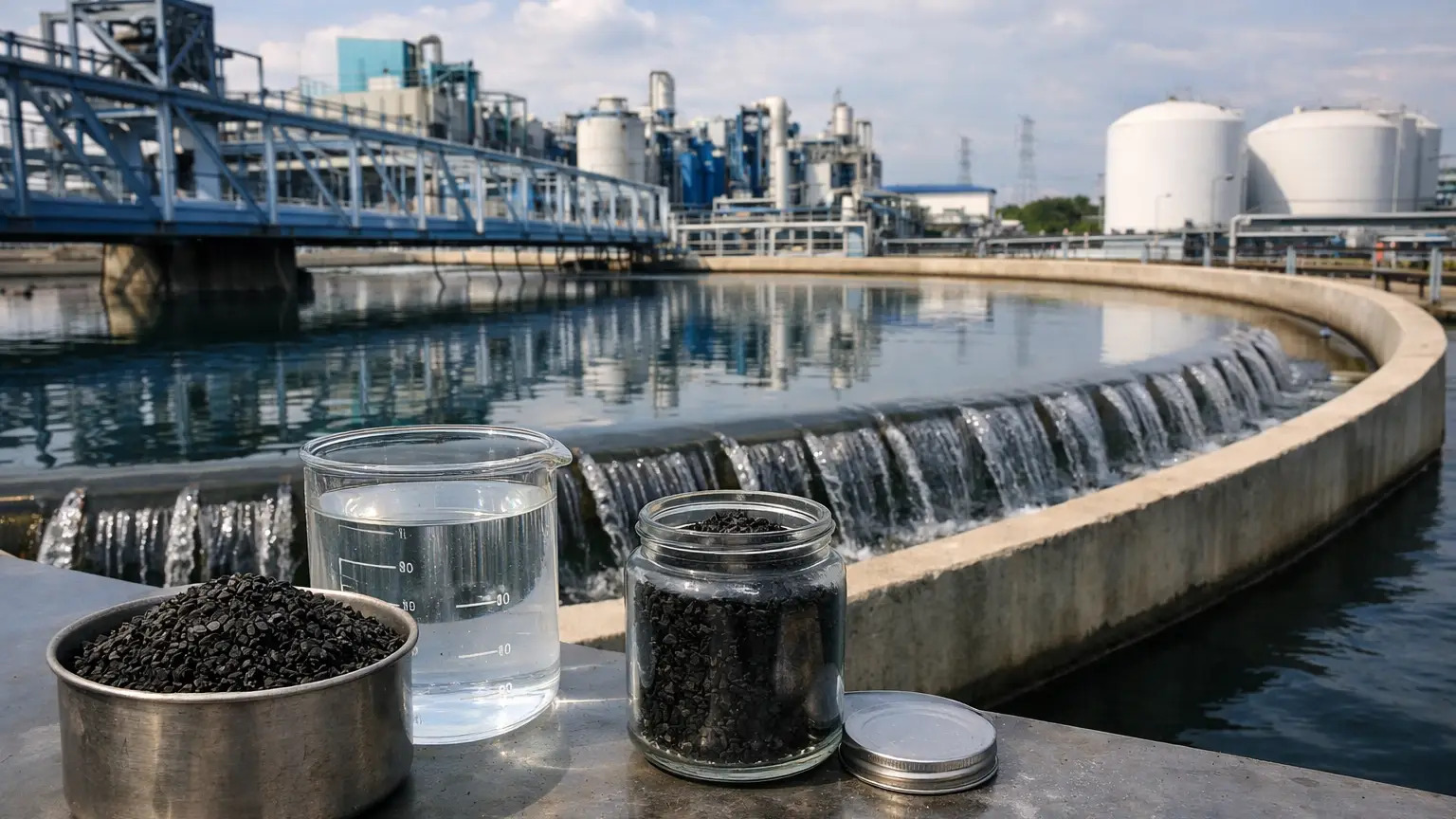
Water treatment is one of the largest applications of Industrial Activated Carbon. Granular Activated Carbon and Powdered Activated Carbon are widely used in municipal, commercial, and industrial water treatment systems depending on the process design, contaminant profile, treatment objective, and required purification performance.
Activated Carbon works through adsorption, where chlorine, organic compounds, odor-causing substances, VOCs, color bodies, and other unwanted contaminants attach to the internal pore surface of the carbon. The effectiveness of this process depends on selecting the correct carbon grade and providing sufficient contact time between the water and the Activated Carbon.
Common Water Treatment Applications
- Chlorine reduction
- Taste and odor control
- Organic contaminant adsorption
- VOC reduction
- Process water purification
- Drinking water polishing
- Wastewater polishing
- Residual contaminant removal
- Industrial effluent treatment
- RO pre-treatment support
- Municipal water purification
- Food and beverage process water treatment
Granular Activated Carbon for Water Treatment
Granular Activated Carbon (GAC) is commonly used in fixed-bed filters, pressure vessels, municipal treatment systems, process water filtration units, and industrial wastewater polishing systems. Its granular structure provides good hydraulic flow, stable filter-bed performance, and suitable contact time for continuous treatment.
High hardness is particularly important in GAC systems because the carbon may experience backwashing, hydraulic movement, handling, and long operating cycles. A strong carbon grade helps reduce particle breakdown, fines generation, and media loss.
Powdered Activated Carbon for Water Treatment
Powdered Activated Carbon (PAC) is generally selected where rapid adsorption and flexible dosing are required. It can be introduced directly into treatment basins, mixing tanks, or process streams and is widely used for seasonal taste and odor problems, color reduction, emergency contaminant control, and selected wastewater treatment applications.
Because PAC has a fine particle size, it provides fast contact with contaminants. The dosage, mixing conditions, contact time, and subsequent separation process must be carefully controlled to achieve consistent treatment performance.
Factors That Influence Water Treatment Performance
The performance of Industrial Activated Carbon in a water treatment system depends on more than the carbon specification alone. The complete treatment system and operating conditions must also be considered.
- Target contaminant: The carbon pore structure should match the contaminant type and molecular size.
- Particle size: Influences adsorption kinetics, hydraulic performance, and pressure drop.
- Flow rate: Excessive flow can reduce the available contact time.
- Contact time: Sufficient contact is required for effective adsorption.
- Filter bed depth: Influences the available adsorption zone and treatment capacity.
- Water chemistry: pH, dissolved solids, competing organics, and temperature can affect adsorption.
- Contaminant concentration: Higher contaminant loading can reduce carbon service life.
- Carbon quality: Iodine value, hardness, ash content, pore distribution, and moisture can influence performance.
Carbure Activated Carbon supports water treatment applications with suitable Granular Activated Carbon and Powdered Activated Carbon grades for drinking water, municipal treatment, industrial process water, wastewater polishing, RO pre-treatment, and other purification requirements.
Industrial Activated Carbon in Air and Gas Purification
Industrial Activated Carbon is also widely used for gas-phase purification where odors, VOCs, solvent vapors, organic gases, and selected industrial contaminants must be adsorbed from air streams.
Pelletized Activated Carbon is often selected because its uniform shape can support smooth airflow, low pressure drop, reduced dust generation, and consistent packed-bed performance.
- Industrial odor control
- VOC adsorption
- HVAC air purification
- Industrial exhaust treatment
- Chemical vapor removal
- Gas purification
- Solvent vapor capture
- Emission control
Industrial Activated Carbon in Gold Recovery
High-quality Granular Activated Carbon is used in gold recovery systems to adsorb dissolved gold complexes from process solutions.
Gold recovery carbon requires strong adsorption capacity, high hardness, suitable particle size, low attrition, and reliable performance during repeated handling and processing.
Coconut Charcoal based Activated Carbon is widely preferred because its mechanical strength helps reduce carbon breakdown, fines generation, and carbon losses in recovery circuits.
- Carbon-in-Pulp systems
- Carbon-in-Leach systems
- Carbon-in-Column systems
- Gold adsorption from process solutions
Key Benefits of Industrial Activated Carbon
Industrial Activated Carbon provides several operational and purification benefits when the correct grade is selected for the application.
- Strong adsorption capacity: Helps capture organic contaminants, gases, odors, colors, and impurities.
- Large internal surface area: Provides extensive adsorption sites within the carbon pore structure.
- Versatile product forms: Available as granular, powdered, and pelletized carbon for different systems.
- Flexible grade selection: Carbon can be selected according to contaminant type and operating conditions.
- High mechanical strength: Important in continuous and fixed-bed industrial applications.
- Reliable purification performance: Supports stable treatment when the correct grade and operating conditions are used.
- Wide industrial compatibility: Suitable for water, air, chemical, food, pharmaceutical, mining, and environmental applications.
Forms of Industrial Activated Carbon
Granular Activated Carbon
Granular Activated Carbon is commonly used in fixed-bed filtration systems, water treatment vessels, gold recovery, chemical purification, process water treatment, and other continuous adsorption systems.
Powdered Activated Carbon
Powdered Activated Carbon is used where rapid adsorption and flexible dosing are required. It is commonly used in water treatment, wastewater treatment, decolorization, food processing, chemical purification, and batch applications.
Pelletized Activated Carbon
Pelletized Activated Carbon is mainly used in air and gas purification systems where uniform airflow, low pressure drop, reduced dust, and mechanical stability are important.
Important Technical Properties of Industrial Activated Carbon
The performance of Industrial Activated Carbon depends on several technical parameters. Buyers should evaluate these according to the intended application rather than selecting carbon based on only one specification.
- Raw Material: Influences pore structure, hardness, ash content, and adsorption behaviour.
- Iodine Value: Commonly used as an indicator of micropore development and adsorption capacity.
- Methylene Blue Value: Helps evaluate adsorption behaviour for larger molecules and color bodies.
- Surface Area: Indicates the internal surface available for adsorption.
- Particle Size: Influences flow rate, pressure drop, contact efficiency, and filtration performance.
- Hardness: Helps reduce carbon breakdown, fines formation, and media loss.
- Ash Content: Important where purity and inorganic residues must be controlled.
- Moisture Content: Influences storage, handling, and usable product quantity.
- Pore Size Distribution: Determines whether the carbon is better suited for smaller or larger contaminant molecules.
How to Select the Right Industrial Activated Carbon Grade
Choosing the right Industrial Activated Carbon grade is important for achieving efficient adsorption, consistent purification performance, and reliable operation. Activated Carbon should not be selected based on a single parameter such as iodine value alone. The carbon properties must be matched with the target contaminant, process medium, operating conditions, and treatment objectives.
Different contaminants have different molecular sizes and adsorption characteristics. Therefore, the pore structure, particle size, surface area, hardness, ash content, and physical form of the Activated Carbon should be evaluated according to the specific industrial application.
Identify the Target Contaminant
The first step is to identify the contaminant or group of contaminants that must be removed. Industrial treatment systems may need to adsorb dissolved organic compounds, color bodies, odors, VOCs, solvent vapors, chemical impurities, process contaminants, or other unwanted substances.
The molecular characteristics and concentration of the target contaminant influence the type of pore structure and adsorption properties required from the Industrial Activated Carbon.
Determine Liquid Phase or Gas Phase Application
The physical form of Activated Carbon should be selected according to whether the purification process involves a liquid or gas stream.
- Granular Activated Carbon (GAC): Commonly used in fixed-bed filters, water treatment systems, process purification units, and continuous liquid-phase adsorption.
- Powdered Activated Carbon (PAC): Suitable for rapid adsorption, batch treatment, direct dosing, decolorization, and selected water and wastewater applications.
- Pelletized Activated Carbon: Commonly used for air and gas purification where uniform airflow, low pressure drop, reduced dust, and mechanical strength are important.
Evaluate Pore Structure and Adsorption Characteristics
Pore size distribution is one of the most important characteristics of Industrial Activated Carbon. Micropores, mesopores, and larger transport pores contribute differently depending on the size and nature of the molecules being adsorbed.
Coconut Charcoal based Steam Activated Carbon generally develops a strong microporous structure, making it suitable for many applications involving smaller contaminant molecules. The required pore distribution, however, should always be matched to the specific application.
Check Iodine Value and Other Adsorption Indicators
Iodine value is commonly used as an indicator of micropore development and adsorption characteristics. However, a higher iodine value does not automatically mean that a carbon grade will perform better for every industrial application.
Other parameters, such as methylene blue value and application-specific adsorption tests, may provide additional information when larger molecules, color bodies, or complex contaminants are involved.
Select the Appropriate Particle Size
Particle size affects adsorption kinetics, flow characteristics, pressure drop, filtration efficiency, and contact between the carbon and process stream.
Smaller particles generally provide faster adsorption kinetics because contaminants can reach the internal adsorption sites more quickly. However, excessively fine particles can increase pressure drop in fixed-bed systems. Larger particles may provide better hydraulic characteristics but can require sufficient contact time for effective adsorption.
Consider Flow Rate and Contact Time
Activated Carbon requires sufficient contact with the contaminated stream for effective adsorption. In fixed-bed systems, the flow rate and bed configuration influence the available contact time between the process stream and the carbon.
If the flow rate is too high or contact time is insufficient, contaminants may pass through the carbon bed before adequate adsorption occurs. System design should therefore balance treatment capacity, pressure drop, carbon quantity, and required purification performance.
Evaluate Hardness and Mechanical Strength
Hardness is particularly important in industrial systems where Activated Carbon is subjected to transportation, loading, backwashing, hydraulic movement, or repeated processing cycles.
High-hardness carbon helps reduce attrition, particle breakdown, fines generation, and carbon loss. Coconut Charcoal based Activated Carbon is widely selected for demanding applications because of its strong mechanical characteristics.
Check Ash Content and Purity Requirements
Ash represents the inorganic residue present in Activated Carbon. The acceptable ash level depends on the application and required product purity.
Applications involving high-purity water, food and beverage processing, pharmaceutical purification, and specialised chemical processes may require tighter control of ash, mineral residues, pH, and other extractable components. In selected applications, Acid Washed Activated Carbon may be considered when reduced acid-soluble mineral impurities are required.
Consider Operating Conditions
The operating environment can significantly influence Activated Carbon performance. Temperature, pH, contaminant concentration, competing compounds, moisture, pressure, and other process conditions should be considered before selecting the final grade.
For gas-phase applications, factors such as humidity, airflow, contaminant concentration, and pressure drop are particularly important. For liquid-phase systems, water chemistry, pH, dissolved organics, suspended solids, flow rate, and contact time can influence adsorption performance.
Important Selection Factors
- Target contaminant: Identify the compounds that must be adsorbed.
- Application phase: Determine whether treatment involves liquid, air, or gas.
- Contaminant concentration: Evaluate the expected contaminant loading.
- Required treated product quality: Define the desired purification level.
- Raw material: Consider how the carbon source influences pore structure and mechanical properties.
- Iodine value: Evaluate micropore development where relevant.
- Pore size distribution: Match the pore structure with the molecular characteristics of the contaminants.
- Particle size: Balance adsorption kinetics with flow and pressure-drop requirements.
- Hardness: Select adequate mechanical strength for the operating system.
- Ash content: Consider purity and inorganic residue requirements.
- Flow rate: Ensure the carbon bed can handle the required process flow.
- Contact time: Provide sufficient interaction between the carbon and contaminants.
- Pressure drop: Consider the hydraulic or airflow resistance of the carbon bed.
- Operating temperature: Evaluate the actual process temperature.
- pH: Consider its influence on both contaminants and adsorption behaviour.
- Filter or process design: Match the carbon grade to the equipment and operating method.
Application Testing Before Final Grade Selection
Technical specifications provide an important starting point, but laboratory testing and application trials can provide a more reliable indication of actual performance. This is particularly important when the process contains multiple contaminants, competing compounds, variable operating conditions, or strict purification requirements.
Testing different Industrial Activated Carbon grades under representative process conditions can help determine adsorption efficiency, carbon consumption, breakthrough behaviour, treatment consistency, and expected operational performance.
Carbure Activated Carbon supports customers in selecting suitable Industrial Activated Carbon grades based on application requirements, contaminant characteristics, operating conditions, and required purification performance. Selecting the correct carbon grade can improve adsorption efficiency, extend useful carbon life, reduce operational losses, and support consistent industrial purification.
Why Coconut Charcoal Based Industrial Activated Carbon?
Coconut Charcoal is an excellent raw material for manufacturing high-performance Industrial Activated Carbon because of its natural hardness and ability to develop a strong microporous structure during steam activation.
At Carbure Activated Carbon, Coconut Charcoal faces superheated steam at 1000°C. This activation process develops the internal pore structure required for effective adsorption.
Coconut Charcoal based Steam Activated Carbon is especially suitable for applications requiring high hardness, reduced attrition, good micropore development, and reliable adsorption performance.
It is widely used in water purification, air purification, gold recovery, VOC removal, gas treatment, and other industrial applications.
Why Choose Carbure Industrial Activated Carbon?
Carbure Activated Carbon manufactures high-performance Industrial Activated Carbon from premium Coconut Charcoal using controlled steam activation technology.
Our product range includes Granular Activated Carbon, Powdered Activated Carbon, and Pelletized Activated Carbon for liquid-phase and gas-phase industrial purification applications.
Carbure Activated Carbon supports water treatment, wastewater treatment, air purification, gold recovery, chemical processing, pharmaceutical purification, food and beverage processing, solvent recovery, VOC adsorption, odor control, and industrial filtration requirements.
We support customers with suitable carbon grades, technical specifications, application guidance, bulk supply, and consistent quality for industrial purification processes.
Industrial Activated Carbon - Final Thoughts
Industrial Activated Carbon is an essential adsorption material used across modern water, air, chemical, mining, food, pharmaceutical, and environmental purification systems.
Its performance depends on selecting the right raw material, pore structure, particle size, product form, hardness, ash content, and adsorption characteristics for the intended application.
For industries requiring strong adsorption performance and mechanical durability, Coconut Charcoal based Steam Activated Carbon provides a reliable solution for demanding purification applications.
FAQs
Industrial Activated Carbon is used in water treatment, wastewater purification, air and gas filtration, gold recovery, pharmaceutical processing, food and beverage purification, chemical treatment, solvent recovery, odor control, and industrial filtration.
Industrial Activated Carbon provides strong adsorption performance, a large internal surface area, flexible grade options, contaminant removal, odor and color reduction, and suitability for both liquid and gas purification systems.
Granular Activated Carbon is generally used in fixed-bed liquid filtration, Powdered Activated Carbon for rapid dosing and batch treatment, and Pelletized Activated Carbon for air and gas purification systems.
Select the grade based on target contaminant, raw material, iodine value, particle size, pore structure, hardness, ash content, flow rate, contact time, operating conditions, and system design.
Coconut Charcoal based Industrial Activated Carbon is preferred for many applications because of its high hardness, developed micropore structure, low attrition, and reliable adsorption performance.
Looking for Industrial Activated Carbon?
Carbure Activated Carbon manufactures high-performance Industrial Activated Carbon, including Granular Activated Carbon, Powdered Activated Carbon, and Pelletized Activated Carbon from premium Coconut Charcoal using advanced steam activation technology.
Contact Carbure Activated Carbon for suitable grades, product specifications, bulk supply, and technical support for industrial purification applications.
