
Impregnated Carbon: Applications, Benefits & Selection Guide
What Is Impregnated Carbon?
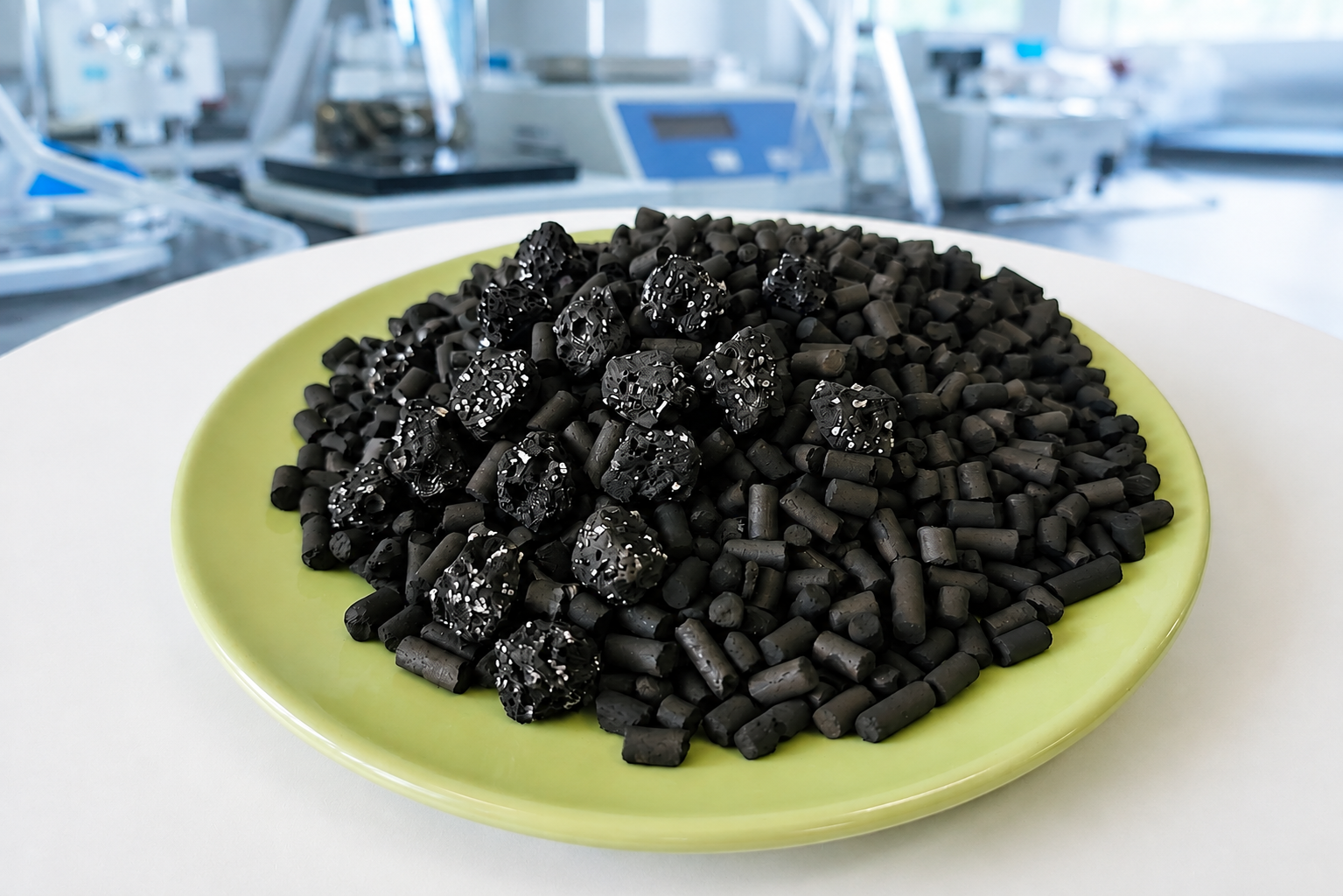
Impregnated Carbon is a specialized form of Activated Carbon that has been treated with selected chemical agents to enhance its performance against specific contaminants. While standard Activated Carbon primarily works through physical adsorption, impregnation introduces additional chemical functionality that can improve the capture of selected gases, vapors, odors, and reactive compounds.
The impregnant is distributed across the Activated Carbon surface and within accessible pores. When the target contaminant enters the carbon structure, it may be physically adsorbed, chemically reacted, converted into another compound, or retained through a combination of adsorption and chemical interaction.
This makes Impregnated Activated Carbon especially valuable where conventional Activated Carbon alone does not provide sufficient performance for a particular contaminant.
Impregnated Carbon is available in granular and pelletized forms depending on the application, airflow requirement, filtration system design, target contaminant, contact time, and operating environment.
Carbure Activated Carbon manufactures high-performance Steam Activated Carbon from premium Coconut Charcoal. During activation, Coconut Charcoal faces superheated steam at 1000°C, developing a highly porous carbon structure that can subsequently be selected and modified for specialized industrial purification requirements.
How Does Impregnated Carbon Work?
Standard Activated Carbon captures many contaminants through adsorption, where molecules move into the internal pore network and attach to the available carbon surface.
Impregnated Carbon extends this capability by adding selected chemical substances to the carbon. These substances provide reactive sites that can interact with contaminants that may otherwise have limited physical adsorption on untreated carbon.
Depending on the formulation, Impregnated Carbon may therefore operate through a combination of physical adsorption, chemisorption, oxidation, neutralization, or other contaminant-specific chemical interactions.
The General Treatment Mechanism
- The contaminated gas or air enters the carbon bed.
- The target compound moves into the Activated Carbon pore network.
- Physical adsorption initially concentrates the contaminant near the active surface.
- The impregnated chemical agent interacts with the target compound.
- The contaminant is retained or transformed within the media.
The exact mechanism depends on the impregnant chemistry and the contaminant being treated. For this reason, one Impregnated Carbon grade should not automatically be substituted for another without confirming application compatibility.
Standard Activated Carbon vs Impregnated Carbon
| Standard Activated Carbon | Impregnated Carbon |
|---|---|
| Primarily relies on physical adsorption | Combines adsorption with contaminant-specific chemical interaction |
| Suitable for many organic compounds and vapors | Designed for selected reactive or difficult-to-adsorb contaminants |
| Performance depends strongly on pore structure | Performance depends on both pore structure and impregnant chemistry |
| General purification applications | Targeted purification applications |
| Grade selected mainly by adsorption characteristics | Grade selected by contaminant chemistry, adsorption characteristics, and operating conditions |
The choice between standard and Impregnated Carbon should therefore be based on the actual contaminant profile rather than assuming chemically treated carbon will always provide better performance.
Major Applications of Impregnated Carbon
Impregnated Carbon is primarily selected for specialized purification processes requiring targeted control of specific contaminants.
| Air & Gas Applications | Industrial Applications |
|---|---|
| Industrial odor control | Chemical processing |
| Process gas purification | Industrial exhaust treatment |
| Selected acidic gas treatment | Waste treatment facilities |
| Selected alkaline gas treatment | Sewage treatment odor control |
| Reactive vapor control | Specialized filtration systems |
| HVAC contaminant control | Process protection applications |
The suitability of any Impregnated Carbon grade must be confirmed against the exact contaminant and operating conditions.
Impregnated Carbon for Air and Gas Purification
Air and gas treatment is one of the most important applications of Impregnated Carbon. Conventional Activated Carbon performs strongly against many VOCs and organic vapors, but some inorganic or highly reactive gases may require an impregnated media.
Specially formulated carbon can increase the treatment efficiency for selected contaminants by providing chemical sites designed to react with the target gas.
Typical Air and Gas Treatment Areas
- Industrial process gas purification
- Odor treatment systems
- Chemical manufacturing facilities
- Industrial exhaust treatment
- Wastewater treatment plant ventilation
- Sewage treatment odor control
- Waste handling facilities
- Selected HVAC filtration applications
- Process equipment protection
- Specialty gas purification
Pelletized Impregnated Carbon may be preferred in many gas-phase systems because its uniform shape can support consistent airflow, controlled pressure drop, good packed-bed distribution, and lower dust generation compared with less uniform media.
Impregnated Carbon for Industrial Odor Control
Industrial odor is often caused by a mixture of organic and inorganic compounds. Standard Activated Carbon may adsorb many organic odor molecules effectively, while selected inorganic or reactive odor compounds may require chemically impregnated carbon.
Impregnated Carbon can therefore form part of a multi-stage odor control system designed around the actual gas composition.
Typical Odor Control Applications
- Sewage treatment plants
- Effluent treatment plants
- Waste handling facilities
- Industrial processing plants
- Chemical storage areas
- Ventilation exhaust systems
- Pumping stations
- Process tanks and enclosed spaces
Successful odor treatment depends on identifying the actual compounds causing the odor. Selecting media based only on the presence of an odor without gas analysis can result in poor carbon performance or premature breakthrough.
What Contaminants Can Impregnated Carbon Target?
Different impregnation systems are designed for different contaminants. Depending on formulation and application requirements, Impregnated Carbon may be selected for treatment of compounds such as:
- Hydrogen sulfide in selected gas treatment applications
- Selected sulfur compounds
- Ammonia in appropriately designed applications
- Selected acidic gases
- Selected alkaline gases
- Reactive industrial vapors
- Selected aldehydes and chemical vapors
- Mercury vapor in specially formulated applications
- Other contaminant-specific industrial gases
Types of Impregnated Carbon
Impregnated Carbon can be manufactured using different chemical treatments depending on the intended purification requirement. These formulations should be treated as application-specific materials rather than interchangeable carbon grades.
Alkaline Impregnated Carbon
Selected alkaline impregnation systems may be used for treatment of certain acidic or reactive gas contaminants. Performance depends on the impregnant concentration, contaminant chemistry, humidity, temperature, and residence time.
Acid Impregnated Carbon
Acid-treated formulations may be selected for certain alkaline or basic contaminants where chemical reaction with the impregnated surface improves capture.
Oxidizing Impregnated Carbon
Selected oxidizing agents may be introduced into Activated Carbon to support conversion or retention of particular gases and odor compounds.
Sulfur Impregnated Carbon
Sulfur-based Impregnated Carbon may be used in selected applications requiring targeted interaction with specific contaminants, subject to the required grade specification and process conditions.
Other proprietary impregnation systems may also be developed according to customer applications and contaminant requirements.
Industrial Applications of Impregnated Carbon
Impregnated Carbon is used across specialized industrial systems where ordinary physical adsorption may not provide sufficient contaminant control.
- Chemical processing plants
- Petrochemical applications
- Industrial air pollution control
- Process gas treatment
- Wastewater treatment facilities
- Effluent treatment plants
- Odor control systems
- Industrial ventilation systems
- Specialized exhaust filtration
- Process equipment protection
- Selected pharmaceutical processing applications
- Specialized purification systems
Application testing is recommended where gas composition varies significantly or where strict outlet concentrations must be achieved.
Key Benefits of Impregnated Carbon
When the correct formulation is selected, Impregnated Carbon can provide several important advantages over conventional Activated Carbon for targeted applications.
- Targeted contaminant control: Impregnation can be designed for specific gases or reactive compounds.
- Enhanced purification performance: Chemical interaction can improve treatment of contaminants with limited physical adsorption.
- Combined treatment mechanism: Provides both Activated Carbon adsorption and chemical reaction capability.
- Industrial odor control: Suitable grades can support treatment of selected odor-causing gases.
- Application flexibility: Different impregnation chemistries can be selected for different contaminants.
- Gas-phase treatment: Particularly useful in specialized air and process gas purification systems.
- Process protection: Contaminant control can help protect sensitive industrial equipment and downstream processes.
- Controlled media design: Granular and pelletized forms can be selected according to airflow, contact time, and pressure-drop requirements.
Important Properties of Impregnated Carbon
Evaluating Impregnated Carbon requires more than checking the conventional Activated Carbon specifications. Both the carbon substrate and impregnation characteristics influence overall performance.
Base Carbon Quality
The raw Activated Carbon provides the pore network required to transport contaminants toward the impregnated active sites. Hardness, pore distribution, ash content, particle size, and physical durability remain important.
Impregnant Type
The chemical treatment must be compatible with the target contaminant. Different impregnating agents provide different chemical functions.
Impregnant Loading
The amount and distribution of the impregnant can influence capacity and performance. Excessive impregnation may also reduce accessible physical adsorption volume, so formulation must be properly controlled.
Particle Size
Particle size affects airflow, pressure drop, diffusion rate, contact efficiency, and bed performance.
Hardness
Strong carbon helps reduce attrition and fines generation during transport, loading, and operation.
Moisture
Moisture can significantly influence some impregnated systems. Depending on the chemistry, humidity may improve, reduce, or otherwise change contaminant removal performance.
Apparent Density
Density influences how much carbon can be loaded into a defined filtration vessel and therefore affects total treatment capacity.
How to Select the Right Impregnated Carbon Grade
Choosing the right Impregnated Carbon requires understanding both the contaminant and the process conditions. Selection should never be based on iodine value alone.
1. Identify the Target Contaminant
The first step is to identify the actual gas, vapor, odor compound, or chemical contaminant that must be controlled. Different compounds require different impregnation chemistries.
2. Determine the Contaminant Concentration
Carbon requirements can change significantly depending on whether the contaminant is present at trace concentration or at a much higher industrial loading.
3. Select the Correct Impregnant Chemistry
The impregnated agent must chemically match the target contaminant. A formulation developed for one contaminant may perform poorly against another.
4. Evaluate the Base Activated Carbon
The carbon substrate still plays an important role. Its pore structure, particle size, hardness, ash content, and physical durability influence transport of the contaminant toward the reactive sites.
5. Consider Humidity
Relative humidity can strongly influence certain impregnated media. Some chemical reactions require moisture, while excessive humidity may reduce performance in other systems.
6. Consider Operating Temperature
Temperature affects adsorption equilibrium, reaction kinetics, moisture conditions, and overall carbon performance.
7. Evaluate Contact Time
The contaminated gas must remain in contact with the media long enough for adsorption and chemical reaction to occur. Insufficient residence time can lead to premature breakthrough.
8. Check Airflow and Pressure Drop
In gas-phase systems, particle size, bed depth, airflow velocity, and carbon form must be balanced to achieve sufficient treatment without excessive pressure drop.
9. Understand Competing Contaminants
Industrial air streams often contain multiple gases. Competing compounds can consume impregnant capacity or occupy adsorption sites, reducing effective service life.
10. Define the Required Outlet Concentration
The acceptable outlet concentration should be established before media selection because different treatment targets require different bed depths, contact times, and carbon capacities.
Important Selection Factors
- Target contaminant
- Contaminant concentration
- Required outlet concentration
- Impregnant chemistry
- Impregnant loading
- Base Activated Carbon quality
- Pore structure
- Particle size
- Hardness
- Ash content
- Moisture and relative humidity
- Operating temperature
- Airflow rate
- Gas velocity
- Contact time
- Bed depth
- Pressure drop
- Presence of competing gases
- Filter vessel design
- Required media service life
Laboratory evaluation, gas analysis, and application trials are recommended for complex gas streams, mixed contaminants, or applications requiring strict outlet performance.
Granular vs Pelletized Impregnated Carbon
| Granular Impregnated Carbon | Pelletized Impregnated Carbon |
|---|---|
| Irregular granular particle structure | Uniform cylindrical structure |
| Suitable for selected fixed-bed systems | Commonly suited to gas-phase filtration systems |
| Particle size selected according to system requirements | Uniform geometry supports consistent airflow |
| Can provide strong contaminant contact | Can help maintain controlled pressure drop |
The correct physical form should be selected according to the filtration vessel, airflow, contact time, pressure drop, contaminant concentration, and required mechanical strength.
Why Choose Carbure Impregnated Carbon?
Carbure Activated Carbon manufactures and supplies Activated Carbon solutions for demanding industrial purification applications, including specialized Impregnated Carbon grades selected according to contaminant and process requirements.
Our base Steam Activated Carbon is manufactured from premium Coconut Charcoal. Coconut Charcoal faces superheated steam at 1000°C during activation, producing a developed pore structure suitable for further processing and application-specific treatment.
Carbure supports customers in evaluating the target contaminant, required carbon form, adsorption characteristics, impregnation requirement, particle size, operating conditions, contact time, and filtration-system design before grade selection.
Impregnated Carbon solutions can be considered for selected industrial air purification, gas treatment, odor control, chemical processing, exhaust filtration, wastewater treatment ventilation, and specialized contaminant-control applications.
Impregnated Carbon - Final Thoughts
Impregnated Carbon extends the capabilities of conventional Activated Carbon by combining porous adsorption with specialized chemical functionality. This makes it an important material for targeted industrial purification applications where standard carbon may not provide adequate performance.
However, successful treatment depends heavily on selecting the correct impregnant for the contaminant. Concentration, humidity, temperature, airflow, contact time, carbon particle size, pressure drop, competing gases, and filter design must all be considered.
Rather than selecting Impregnated Carbon solely by conventional specifications such as iodine value, industries should evaluate the complete relationship between the carbon substrate, impregnant chemistry, target contaminant, and operating environment.
Application testing is recommended before finalizing a grade for critical or technically demanding purification systems.
FAQs
Impregnated Carbon is Activated Carbon treated with selected chemical agents to improve its ability to capture or react with specific contaminants that may not be efficiently controlled by conventional Activated Carbon alone.
Standard Activated Carbon primarily relies on physical adsorption, while Impregnated Carbon combines the porous adsorption properties of Activated Carbon with chemical functionality designed for specific contaminants.
Impregnated Carbon is used in selected industrial air and gas purification, odor control, process gas treatment, chemical processing, exhaust filtration, wastewater treatment ventilation, and specialized contaminant-control systems.
No. Different contaminants require different impregnation chemistries. A carbon grade designed for one gas should not automatically be assumed suitable for another contaminant.
Benefits include targeted contaminant control, improved treatment of selected reactive gases, combined adsorption and chemical reaction mechanisms, specialized odor control, and flexibility for contaminant-specific purification systems.
Select the grade according to the target contaminant, concentration, impregnant chemistry, base carbon quality, particle size, humidity, temperature, contact time, airflow, pressure drop, competing gases, and required treatment performance.
Humidity and temperature can affect both adsorption and chemical reaction mechanisms. Their influence depends on the specific impregnant chemistry and contaminant being treated.
Looking for Impregnated Carbon for Your Application?
Carbure Activated Carbon supplies specialized Impregnated Carbon solutions for selected air purification, gas treatment, odor control, industrial exhaust, chemical processing, and contaminant-specific filtration requirements.
Contact Carbure Activated Carbon with your target contaminant, concentration, airflow, operating conditions, and treatment requirements to identify a suitable Activated Carbon grade.
