
Groundwater Remediation Using Activated Carbon | Effective Contaminant Removal Solutions
Introduction
Groundwater Remediation is an important environmental treatment process used to remove contaminants from polluted groundwater and restore water quality. Groundwater can become contaminated through industrial activities, chemical spills, leaking storage tanks, agricultural activities, landfills, and other sources of pollution.
Depending on the contamination source, groundwater may contain volatile organic compounds (VOCs), petroleum hydrocarbons, chlorinated solvents, pesticides, dissolved organic compounds, and other contaminants. Effective remediation requires a treatment approach that is selected according to the type, concentration, and characteristics of the contaminants present in the groundwater.
Activated Carbon is widely used in Groundwater Remediation because of its highly porous structure and strong adsorption capacity. It can adsorb many organic contaminants from water and is commonly incorporated into treatment systems for groundwater polishing and contaminant removal.
Carbure Activated Carbon manufactures high-performance Activated Carbon for water treatment and environmental applications, supporting groundwater purification systems that require reliable adsorption performance and consistent carbon quality.
What is Groundwater Remediation?
Groundwater Remediation refers to the treatment and management of contaminated groundwater to reduce pollutant concentrations and improve groundwater quality. The objective is to control or remove contaminants so that the affected groundwater can meet the required environmental, regulatory, or site-specific treatment objectives.
Groundwater contamination can originate from industrial facilities, manufacturing sites, petroleum storage areas, waste disposal locations, agricultural operations, and accidental chemical releases. Common contaminants include VOCs, hydrocarbons, solvents, pesticides, and other dissolved organic compounds.
Different remediation technologies may be used depending on the site conditions and contaminant profile. These can include pump-and-treat systems, activated carbon adsorption, air stripping, biological treatment, chemical oxidation, filtration, and other treatment technologies.
Activated Carbon is particularly valuable when dissolved organic contaminants need to be removed from extracted groundwater or when additional polishing is required after primary treatment.
Groundwater Remediation Process
The Groundwater Remediation process begins with a detailed assessment of the contaminated site and groundwater quality. Water samples are typically evaluated to determine contaminant type, concentration, pH, dissolved organic matter, and other parameters that influence treatment performance.
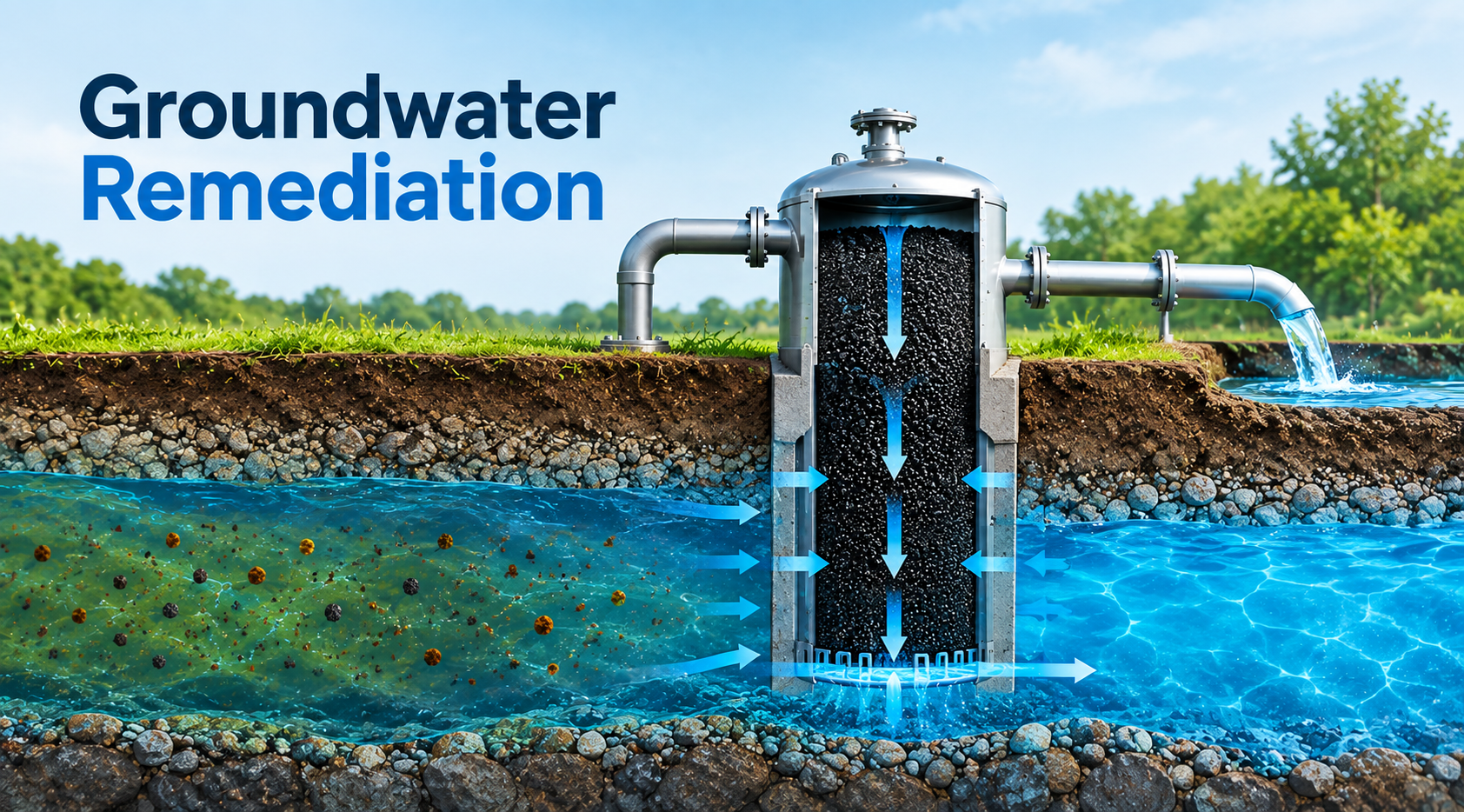
In pump-and-treat applications, contaminated groundwater is extracted through wells and transferred to an above-ground treatment system. The water can then pass through one or more treatment stages designed to remove specific contaminants.
Activated Carbon can be used as an adsorption medium within the treatment system. As contaminated groundwater passes through the carbon bed, selected dissolved organic compounds are adsorbed onto the internal pore surfaces of the Activated Carbon.
The treated water can then be monitored to determine whether the required contaminant reduction has been achieved. The carbon media is replaced, reactivated, or otherwise managed when its adsorption capacity becomes exhausted, depending on the system design and applicable requirements.
The effectiveness of Activated Carbon in Groundwater Remediation depends on factors such as contaminant concentration, carbon grade, pore structure, flow rate, empty bed contact time, temperature, competing compounds, and overall groundwater chemistry.
Role of Activated Carbon in Groundwater Remediation
Activated Carbon plays an important role in Groundwater Remediation by providing a high-surface-area adsorption medium for the removal of selected dissolved contaminants. Its extensive internal pore network allows organic molecules to be retained through adsorption as contaminated water passes through the carbon bed.
Granular Activated Carbon is commonly used in fixed-bed water treatment systems because it can provide continuous contact between groundwater and the adsorption media. The carbon grade can be selected according to the contaminant profile, water chemistry, flow conditions, and required treatment performance.
Activated Carbon can be particularly useful for treating many organic contaminants, including certain VOCs, petroleum-related compounds, solvents, and other adsorbable substances. The actual removal efficiency should be determined through appropriate laboratory testing or pilot trials for the specific groundwater.
Correct carbon selection is therefore an important part of designing an effective groundwater treatment system. Parameters such as adsorption capacity, pore size distribution, hardness, particle size, ash content, and hydraulic characteristics can influence the overall performance of the carbon bed.
Benefits of Activated Carbon for Groundwater Remediation
High-quality Activated Carbon can provide several benefits when incorporated into a properly designed Groundwater Remediation system. Its strong adsorption properties make it suitable for treating groundwater containing various dissolved organic contaminants.
Activated Carbon can help reduce contaminant concentrations, improve treated water quality, and provide an additional polishing stage following other remediation processes. Granular grades can also be incorporated into fixed-bed systems for continuous groundwater treatment.
The versatility of Activated Carbon allows treatment systems to be designed according to site-specific requirements. Carbon selection, bed configuration, flow rate, contact time, and replacement frequency can be optimized according to the characteristics of the contaminated groundwater.
For environmental applications, Activated Carbon can therefore serve as a reliable adsorption technology for groundwater treatment when the target contaminants have suitable adsorption characteristics.
Groundwater Remediation Applications
Groundwater Remediation using Activated Carbon can be applied across a wide range of contaminated sites where dissolved organic pollutants require removal or polishing. Treatment requirements vary depending on the source and composition of the groundwater contamination.
Industrial Contaminated Sites
Industrial facilities may generate groundwater contamination through manufacturing processes, chemical handling, storage activities, or accidental releases. Activated Carbon treatment can be incorporated into groundwater treatment systems to adsorb suitable organic contaminants.
Petroleum and Fuel Contamination
Sites affected by petroleum products, fuel storage, or hydrocarbon releases may require groundwater treatment. Activated Carbon can be used to adsorb selected petroleum-related organic compounds from extracted groundwater.
VOC and Solvent Contamination
Volatile organic compounds and industrial solvents can contaminate groundwater around manufacturing and commercial sites. Properly selected Activated Carbon can help remove many adsorbable organic contaminants from groundwater treatment streams.
Landfill and Waste Sites
Groundwater surrounding landfills and waste disposal areas can contain dissolved organic contaminants. Activated Carbon adsorption may be incorporated as part of a broader groundwater treatment strategy where suitable contaminants are present.
Environmental Treatment Systems
Activated Carbon can also be used in engineered environmental treatment systems designed to reduce contaminant concentrations before treated groundwater is discharged, reused, or subjected to additional treatment stages.
Activated Carbon Selection Factors for Groundwater Remediation
The performance of Activated Carbon in Groundwater Remediation depends on selecting a carbon grade that is appropriate for the specific groundwater characteristics and target contaminants.
Contaminant Type: The chemical characteristics and molecular size of the target contaminants influence their adsorption onto Activated Carbon. Carbon selection should therefore be based on the actual contaminant profile.
Pore Structure: Activated Carbon contains a network of micropores, mesopores, and larger pores. The pore structure should provide suitable adsorption sites for the contaminants being treated.
Adsorption Capacity: The adsorption capacity of the carbon influences the quantity of contaminants that can be retained before the media requires replacement or reactivation.
Particle Size: Particle size affects pressure drop, hydraulic performance, contact efficiency, and filtration characteristics within a groundwater treatment system.
Hardness: Good mechanical strength is important for granular Activated Carbon used in continuous treatment systems, particularly where the media may be exposed to repeated handling or hydraulic movement.
Empty Bed Contact Time: Adequate contact between groundwater and Activated Carbon is required to achieve effective adsorption. System design should consider flow rate and the required treatment performance.
Water Chemistry: pH, dissolved organic matter, competing contaminants, temperature, and other groundwater characteristics can influence adsorption performance and carbon bed life.
Granular Activated Carbon for Groundwater Remediation
Granular Activated Carbon is commonly considered for continuous Groundwater Remediation systems because its particle size allows it to be retained within fixed-bed adsorption vessels while contaminated groundwater flows through the carbon media.
As groundwater passes through the carbon bed, dissolved contaminants come into contact with the internal pore surfaces of the Activated Carbon. Suitable organic compounds can then be retained through adsorption, reducing their concentration in the treated water.
The performance and service life of a granular carbon bed depend on contaminant loading, carbon characteristics, flow rate, empty bed contact time, competing compounds, and groundwater chemistry. Regular monitoring of treated water quality helps determine when the carbon requires replacement or other media management.
Why Choose Carbure Activated Carbon for Groundwater Remediation?
Carbure Activated Carbon is an Activated Carbon Manufacturer in India supplying high-performance carbon solutions for water treatment, wastewater treatment, environmental purification, and industrial adsorption applications.
Our Steam Activated Carbon is manufactured from premium Coconut Charcoal using controlled activation technology. During activation, Coconut Charcoal faces superheated steam at 1000°C, developing a highly porous structure with strong adsorption characteristics.
For Groundwater Remediation, suitable Activated Carbon grades can be selected based on the target contaminants, groundwater chemistry, adsorption requirements, flow conditions, contact time, and treatment system configuration.
Carbure Activated Carbon supports industrial and environmental applications with consistent product quality, technical expertise, customized carbon solutions, and dependable supply capabilities for domestic and international requirements.
Frequently Asked Questions - Groundwater Remediation
Groundwater Remediation is the process of treating contaminated groundwater to reduce pollutants and improve water quality. Different technologies may be used depending on the contaminant type, concentration, site conditions, and treatment objectives.
Activated Carbon provides a highly porous adsorption surface that can capture many dissolved organic contaminants from groundwater. It can be used in fixed-bed treatment systems and as a polishing stage in groundwater remediation processes.
Activated Carbon can effectively adsorb many organic contaminants, including certain volatile organic compounds, petroleum-related compounds, solvents, and other dissolved organic substances. Actual performance depends on the contaminant characteristics and groundwater chemistry.
The appropriate Activated Carbon grade depends on the target contaminants, groundwater chemistry, flow rate, empty bed contact time, adsorption requirements, and treatment system design. Granular Activated Carbon is commonly considered for fixed-bed groundwater treatment systems.
Yes. Carbure Activated Carbon manufactures and supplies Activated Carbon for water treatment and environmental applications. Suitable carbon grades can be evaluated according to the groundwater contaminant profile and specific treatment requirements.
In a typical treatment system, contaminated groundwater is passed through an Activated Carbon bed. Suitable dissolved contaminants are adsorbed onto the carbon, and the treated water is then monitored to evaluate treatment performance and determine the condition of the carbon media.
