
Granular Activated Charcoal: Applications, Benefits & Selection Guide
What Is Granular Activated Charcoal?
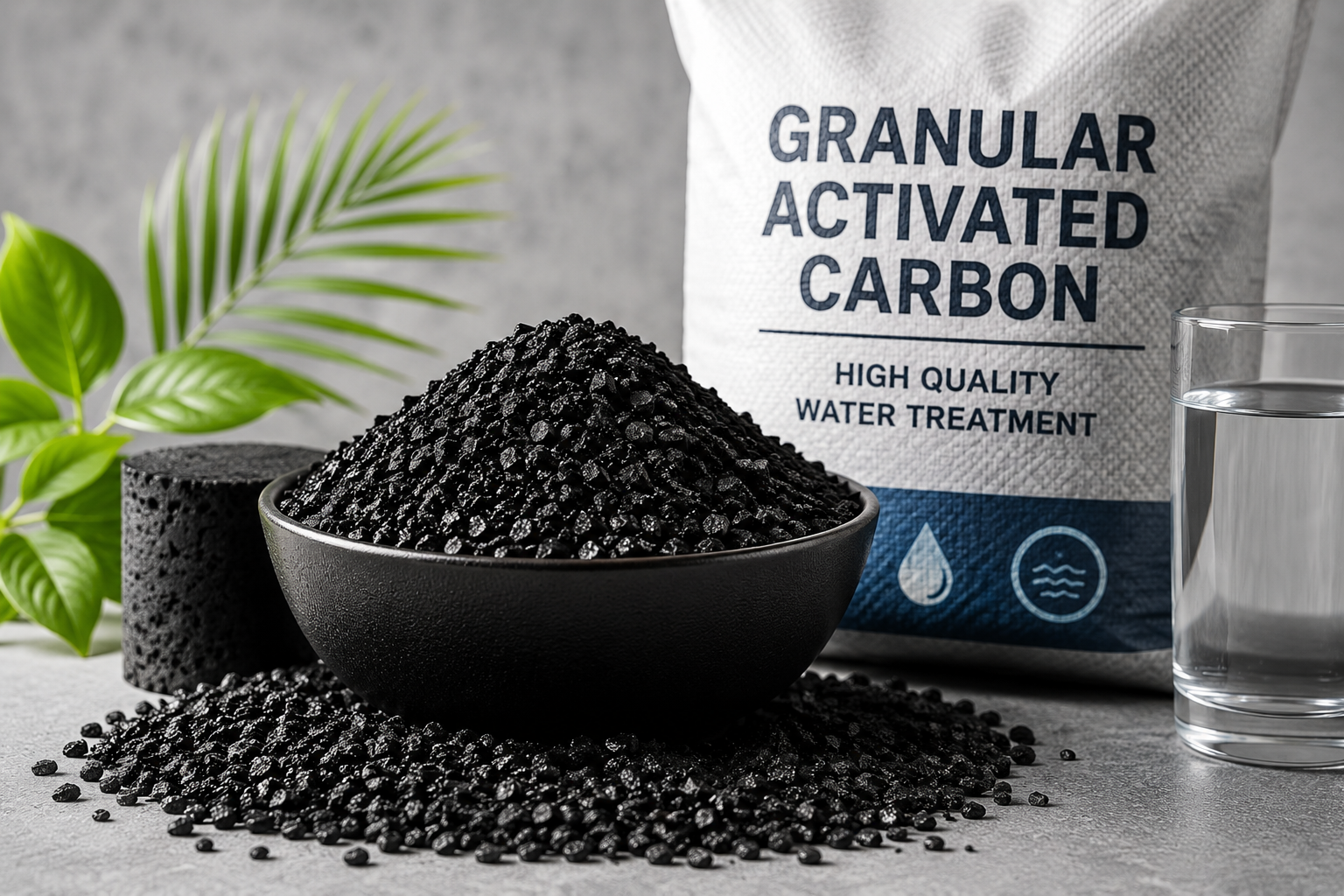
Granular Activated Charcoal is a highly porous form of Activated Carbon supplied in granular particle sizes for continuous adsorption and filtration applications. The terms Granular Activated Charcoal and Granular Activated Carbon are often used interchangeably, particularly across industrial and commercial purification markets.
Unlike Powdered Activated Carbon, which is generally dosed directly into a treatment stream, Granular Activated Charcoal is commonly packed inside filters, adsorption vessels, columns, and fixed-bed treatment systems. Liquids or gases pass through the carbon bed, allowing contaminants to enter the internal pore structure and adsorb onto the carbon surface.
The effectiveness of Granular Activated Charcoal depends on raw material, activation conditions, pore size distribution, iodine value, particle size, hardness, ash content, contact time, and the characteristics of the contaminants being treated.
Carbure Activated Carbon manufactures high-performance Steam Activated Carbon from premium Coconut Charcoal. During activation, Coconut Charcoal faces superheated steam at 1000°C, developing a strong internal pore network for demanding industrial purification applications.
How Does Granular Activated Charcoal Work?
Granular Activated Charcoal works primarily through adsorption. As a contaminated liquid or gas passes through the carbon bed, unwanted molecules move through the external openings and into the internal pore structure.
The contaminants are attracted to and retained on the internal carbon surface. Because Activated Carbon contains an extensive pore network, a relatively small quantity of carbon can provide a very large internal adsorption area.
Granular carbon is particularly useful in fixed-bed systems because its particle size allows the treatment stream to pass through the bed while maintaining sufficient contact between the carbon and contaminants.
Factors Affecting Adsorption Performance
- Contaminant type and molecular size
- Contaminant concentration
- Carbon pore structure
- Particle size
- Bed depth
- Flow rate
- Contact time
- Temperature
- pH
- Competing compounds
A properly designed filtration system must balance adsorption efficiency, flow performance, pressure drop, bed depth, and useful carbon life.
Major Applications of Granular Activated Charcoal
Granular Activated Charcoal is used across multiple industries where continuous liquid-phase or gas-phase adsorption is required.
| Liquid Phase Applications | Industrial Purification Applications |
|---|---|
| Drinking water treatment | Gold recovery |
| Municipal water purification | Chemical purification |
| Industrial process water | Food and beverage processing |
| Wastewater polishing | Pharmaceutical purification |
| RO pre-treatment | Solvent purification |
| Chlorine reduction | Industrial filtration systems |
Granular Activated Charcoal in Water Treatment
Water treatment is one of the most important applications of Granular Activated Charcoal. It is commonly used in fixed-bed filters and adsorption vessels for drinking water, municipal water, process water, industrial water, and wastewater treatment.
As water passes through the granular carbon bed, contaminants interact with the internal pore surface. Depending on the carbon grade and treatment conditions, Granular Activated Charcoal can support the reduction of chlorine, taste and odor compounds, VOCs, and selected dissolved organic contaminants.
Common Water Treatment Uses
- Chlorine reduction
- Taste and odor control
- Organic contaminant adsorption
- VOC reduction
- Process water purification
- Drinking water polishing
- Wastewater polishing
- RO pre-treatment support
Performance depends on carbon grade, particle size, bed depth, empty bed contact time, flow rate, water chemistry, contaminant loading, and system maintenance.
Granular Activated Charcoal in Gold Recovery
Gold recovery is a specialised application of Granular Activated Charcoal. High-quality granular carbon is used to adsorb dissolved gold complexes from process solutions in mining and metallurgical recovery circuits.
For gold recovery, the carbon must combine strong adsorption performance with high mechanical strength because it is repeatedly moved, screened, washed, and processed within the recovery circuit.
Common Gold Recovery Systems
- Carbon-in-Pulp (CIP)
- Carbon-in-Leach (CIL)
- Carbon-in-Column (CIC)
- Gold adsorption from process solutions
Coconut Charcoal based Granular Activated Carbon is widely preferred for gold recovery because of its high hardness and ability to withstand mechanical handling with reduced attrition and fines generation.
Granular Activated Charcoal in Industrial Purification
Granular Activated Charcoal is used in industrial purification processes where continuous contact between the treatment stream and the carbon is required.
- Chemical product purification
- Organic impurity adsorption
- Process liquid polishing
- Food and beverage process water treatment
- Pharmaceutical process purification
- Solvent purification
- Industrial wastewater treatment
The required carbon grade varies significantly according to the impurity profile, molecular size, process chemistry, contact time, and required final product quality.
Key Benefits of Granular Activated Charcoal
Granular Activated Charcoal offers several advantages for industrial and water purification systems when properly selected and operated.
- Strong adsorption performance: Provides an extensive internal pore structure for contaminant capture.
- Suitable for continuous filtration: Granular form is well suited for fixed-bed and column systems.
- Good hydraulic performance: Appropriate particle size supports controlled flow through the carbon bed.
- High mechanical strength: Important for handling, backwashing, and continuous industrial operation.
- Reduced fines generation: High-hardness carbon helps reduce particle breakdown and carbon loss.
- Flexible grade selection: Different particle sizes and adsorption characteristics can be selected for different applications.
- Wide application range: Suitable for water treatment, gold recovery, chemical processing, food processing, and industrial purification.
Important Technical Properties of Granular Activated Charcoal
The performance of Granular Activated Charcoal should be evaluated using multiple technical parameters rather than one specification alone.
- Raw Material: Influences pore structure, hardness, ash content, and adsorption behaviour.
- Iodine Value: Commonly used as an indicator of micropore development and adsorption capacity.
- Particle Size: Influences flow, pressure drop, adsorption kinetics, and contact efficiency.
- Hardness: Important for reducing attrition, fines generation, and media loss.
- Ash Content: Indicates the inorganic residue present in the carbon.
- Moisture: Important for storage, handling, and usable product quantity.
- Surface Area: Indicates the internal area available for adsorption.
- Pore Size Distribution: Determines suitability for contaminants of different molecular sizes.
- Apparent Density: Influences the mass of carbon that can be loaded into a given filter volume.
The importance of each parameter depends on the specific application and treatment objective.
How to Select the Right Granular Activated Charcoal Grade
Choosing the correct Granular Activated Charcoal grade requires matching the carbon properties to the target contaminant, treatment medium, system design, and operating conditions.
1. Identify the Target Contaminant
Determine whether the carbon must remove chlorine, taste and odor compounds, VOCs, organic contaminants, dissolved impurities, chemical residues, or another target compound.
2. Select the Appropriate Pore Structure
Different contaminants require different pore structures. Micropores are important for many smaller molecules, while mesopores and larger transport pores improve access for larger contaminants.
3. Choose the Right Particle Size
Particle size influences hydraulic performance, adsorption kinetics, pressure drop, and contact efficiency. Smaller granules generally provide faster adsorption but may produce greater pressure drop, while larger granules can provide easier flow but may require longer contact time.
4. Evaluate Hardness
High hardness is important in systems involving backwashing, hydraulic movement, repeated handling, or mechanical processing. Carbon with poor mechanical strength can break down and generate unwanted fines.
5. Check Ash and Purity Requirements
The acceptable ash level depends on the application. Sensitive water, food, pharmaceutical, or chemical applications may require tighter control over inorganic residues and other product specifications.
6. Consider Contact Time and Flow Rate
The treatment stream must remain in contact with the carbon long enough for adsorption to occur. Excessive flow through a shallow carbon bed can reduce treatment efficiency and accelerate breakthrough.
7. Evaluate Operating Conditions
Temperature, pH, contaminant concentration, competing compounds, water chemistry, humidity, and process conditions can all influence Activated Carbon performance.
Important Selection Factors
- Target contaminant
- Liquid or gas phase application
- Contaminant concentration
- Required treatment quality
- Raw material
- Iodine value
- Pore size distribution
- Particle size
- Hardness
- Ash content
- Flow rate
- Contact time
- Pressure drop
- Operating temperature
- pH
- Filter-bed design
Laboratory testing and application trials are recommended for complex contaminants or processes requiring strict purification performance.
Why Coconut Charcoal Based Granular Activated Charcoal?
Coconut Charcoal is widely used for manufacturing high-quality Granular Activated Charcoal because of its natural hardness and ability to develop a strong microporous structure during steam activation.
At Carbure Activated Carbon, Coconut Charcoal faces superheated steam at 1000°C. This activation process develops the internal pore network that provides the adsorption characteristics required for industrial purification.
Coconut Charcoal based Granular Activated Carbon is especially suitable for applications where mechanical strength, reduced attrition, micropore development, and consistent adsorption performance are important.
Its properties make it widely used in water treatment, gold recovery, process purification, and other continuous filtration applications.
Why Choose Carbure Granular Activated Charcoal?
Carbure Activated Carbon manufactures high-performance Granular Activated Charcoal and Granular Activated Carbon from premium Coconut Charcoal using controlled steam activation technology.
Our granular carbon solutions are engineered for drinking water treatment, industrial process water, wastewater polishing, gold recovery, chemical purification, food and beverage processing, pharmaceutical applications, and industrial filtration systems.
Carbure Activated Carbon supports customers with suitable grade selection, technical specifications, application guidance, consistent quality, and bulk supply for domestic and global requirements.
Granular Activated Charcoal - Final Thoughts
Granular Activated Charcoal is a versatile adsorption material used in continuous purification systems across water treatment, gold recovery, chemical processing, food and beverage purification, and other industrial applications.
Its effectiveness depends on selecting the correct raw material, pore structure, particle size, hardness, ash content, contact time, and operating conditions.
Coconut Charcoal based Steam Activated Carbon provides a strong combination of adsorption performance, mechanical durability, and operational reliability for demanding granular filtration applications.
FAQs
Granular Activated Charcoal is used in drinking water treatment, industrial water purification, wastewater polishing, gold recovery, chemical processing, food and beverage purification, pharmaceutical applications, and industrial filtration systems.
Granular Activated Charcoal consists of larger particles commonly used in fixed-bed filters and continuous treatment systems, while Powdered Activated Carbon contains much finer particles and is typically dosed directly into liquid treatment processes.
Key benefits include strong adsorption performance, suitability for continuous filtration, good flow characteristics, high mechanical strength, reduced fines generation, and flexibility across multiple industrial applications.
Select the grade based on the target contaminant, raw material, iodine value, pore structure, particle size, hardness, ash content, contact time, flow rate, pressure drop, and treatment-system design.
Coconut Charcoal based Granular Activated Charcoal is preferred for many applications because of its high hardness, strong micropore development, low attrition, and reliable adsorption performance.
Looking for Granular Activated Charcoal?
Carbure Activated Carbon manufactures high-performance Granular Activated Charcoal from premium Coconut Charcoal using advanced steam activation technology. Our granular grades are designed for water treatment, wastewater purification, gold recovery, chemical processing, food and beverage purification, and industrial filtration.
Contact Carbure Activated Carbon for suitable grades, product specifications, bulk supply, and technical support.
