
Coconut Shell Based Steam Activated Carbon: Manufacturing, Properties & Industrial Applications
Introduction to Coconut Shell Based Steam Activated Carbon
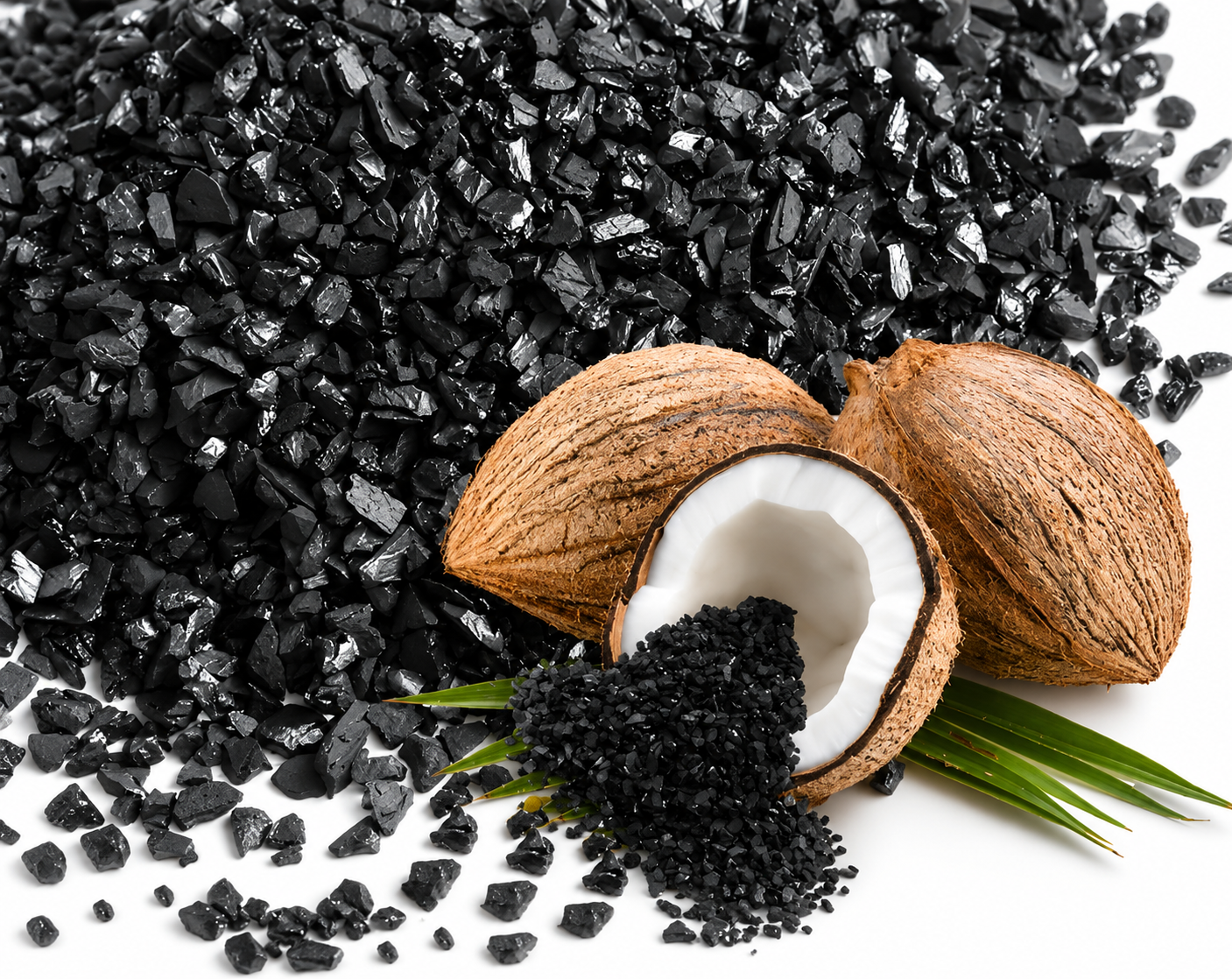
Coconut Shell Based Steam Activated Carbon is a high-performance porous carbon adsorbent manufactured from carefully selected coconut shells through controlled carbonization and steam activation processes. It is widely used in industrial purification applications because suitable grades offer developed microporosity, mechanical hardness and adsorption capacity.
The manufacturing process begins with converting coconut shells into Coconut Charcoal. The carbonized material is then exposed to superheated steam at elevated temperatures, allowing a network of microscopic pores to develop within the carbon structure.
This porous structure provides extensive internal surface area where selected dissolved organic compounds, gases, vapors, odor-causing substances and other suitable contaminants can be retained through adsorption.
High-quality Coconut Shell Based Steam Activated Carbon is used in water purification, wastewater treatment, air filtration, gas purification, gold recovery, chemical processing, food and beverage manufacturing and other industrial applications.
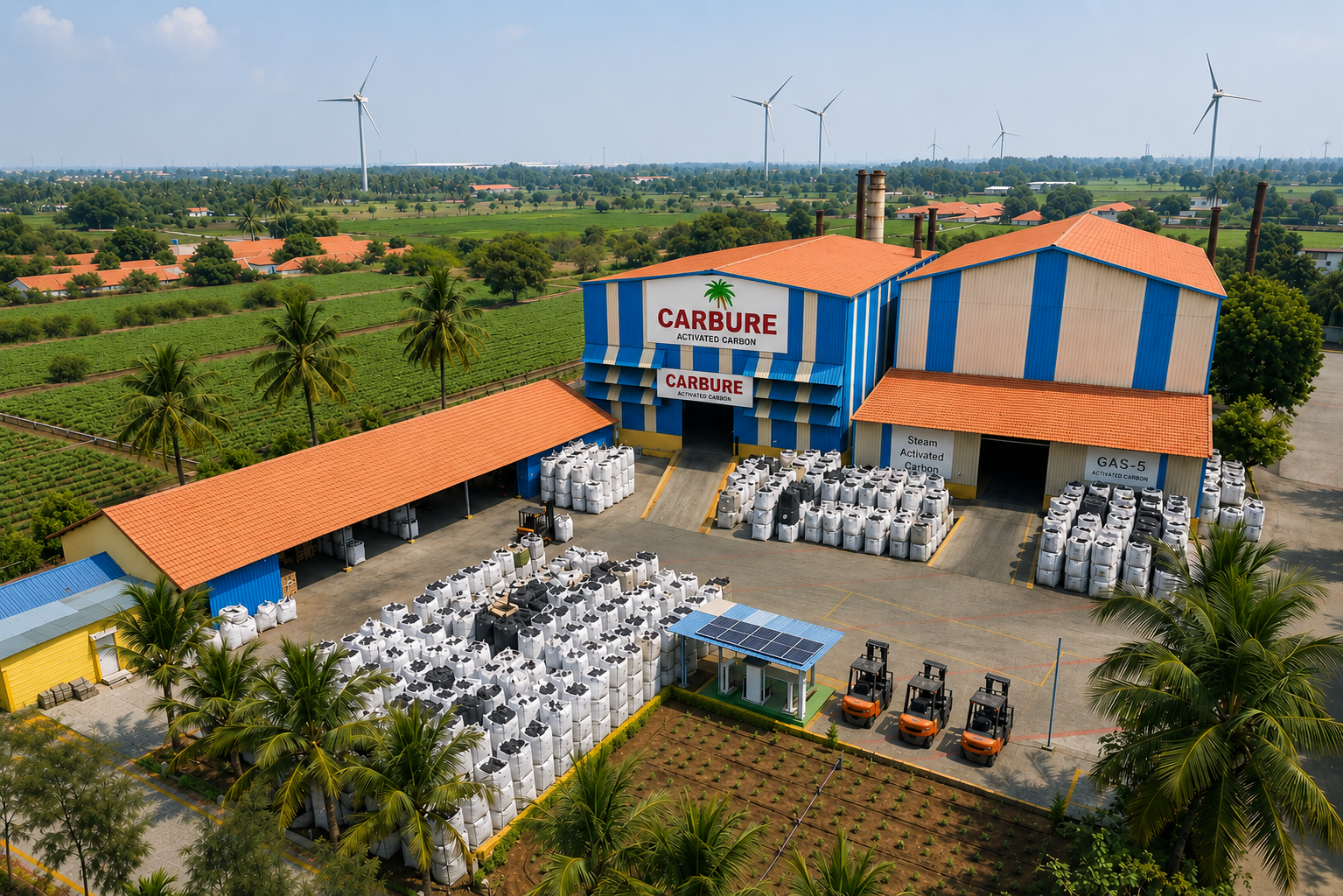
Carbure Activated Carbon Pvt. Ltd. manufactures coconut shell-based Steam Activated Carbon in India for industrial customers requiring consistent product characteristics, suitable adsorption performance and application-specific carbon grades.
What is Coconut Shell Based Steam Activated Carbon?
Coconut Shell Based Steam Activated Carbon is an adsorbent produced by activating carbonized coconut shells with steam under controlled high-temperature conditions.
Unlike ordinary Coconut Charcoal, which has a comparatively limited accessible adsorption structure, Steam Activated Carbon undergoes additional processing to develop an extensive internal network of pores.
During activation, controlled reactions between steam and the carbon structure remove portions of carbon and create additional pore volume. This increases the internal surface available for adsorption.
The resulting material can be processed into different particle sizes and grades depending on the intended industrial application.
Granular Activated Carbon (GAC) is commonly used in fixed-bed filtration systems, while Powdered Activated Carbon (PAC) may be used in suitable dosing, batch treatment and liquid purification processes.
The adsorption performance of Coconut Shell Based Steam Activated Carbon depends on pore size distribution, surface chemistry, particle size, contaminant properties, contact time and other operating conditions.
For this reason, the correct grade should be selected according to the specific treatment requirement rather than surface area or iodine value alone.
How Coconut Shell Based Steam Activated Carbon is Manufactured
The manufacturing of Coconut Shell Based Steam Activated Carbon involves several controlled stages that influence the final carbon's pore structure, adsorption properties, mechanical strength and product consistency.
1. Selection of Coconut Shells
The process begins with selecting suitable coconut shells. Raw material quality influences carbon yield, ash content, physical characteristics and the consistency of the final Activated Carbon.
Dense coconut shells are commonly selected for producing carbon grades requiring developed microporosity and mechanical hardness.
2. Cleaning and Drying
The coconut shells are cleaned to reduce unwanted foreign matter such as soil, fibers and other contaminants.
Drying helps control moisture content and supports consistent carbonization conditions.
3. Controlled Carbonization
The prepared coconut shells are heated under controlled conditions with limited oxygen availability. During carbonization, volatile compounds are released, leaving behind a carbon-rich material known as Coconut Charcoal.
The quality of the Coconut Charcoal influences the subsequent activation process and final carbon characteristics.
4. Steam Activation at 1000°C
The Coconut Charcoal is exposed to superheated steam at 1000°C under controlled activation conditions.
Steam reacts with portions of the carbon structure, creating and enlarging microscopic pores. This process develops the internal surface area required for adsorption.
The degree of activation must be controlled because excessive activation can reduce carbon yield and affect mechanical strength.
5. Cooling and Stabilization
After activation, the carbon is cooled under controlled conditions to prevent unwanted oxidation or combustion.
Proper cooling supports safe handling and helps preserve the required product characteristics.
6. Crushing and Screening
The activated material is processed and classified into appropriate particle sizes according to the required product grade.
Granular grades are commonly used in fixed-bed systems, while finer grades may be produced for dosing and batch treatment applications.
7. Quality Testing
Finished Steam Activated Carbon is evaluated using relevant physical and adsorption parameters, including iodine number, moisture content, ash content, particle size distribution, hardness, bulk density and other application-specific specifications.
8. Packaging and Supply
After quality evaluation, the Activated Carbon is packaged according to the product grade and customer requirements.
Suitable packaging and storage conditions help protect the material from moisture and unwanted contamination during transportation.
Important Properties of Coconut Shell Based Steam Activated Carbon
The performance of Coconut Shell Based Steam Activated Carbon depends on several physical and adsorption characteristics. These properties influence its suitability for different industrial purification applications.
- Developed microporosity: Coconut shell-based carbon can provide a substantial volume of micropores suitable for adsorbing selected smaller molecules.
- High internal surface area: Steam activation develops extensive internal surfaces where suitable contaminants can be adsorbed.
- Mechanical hardness: Properly manufactured granular grades can provide useful resistance to breakage during handling and filtration.
- Controlled ash content: Ash levels should be evaluated according to the purity requirements of the intended application.
- Particle size distribution: Suitable particle sizing supports filtration performance, pressure-drop control and carbon handling.
- Adsorption activity: Carbon performance depends on the target contaminants and the accessibility of suitable adsorption sites.
- Bulk density: Influences packaging, transport, bed volume and certain system design requirements.
- Moisture content: Controlled moisture supports storage, handling and consistent product specifications.
- Regeneration potential: Certain grades can be regenerated and reused in appropriately designed industrial systems.
- Renewable raw material: Coconut shells are an agricultural by-product that can be used as a carbon-rich manufacturing feedstock.
These characteristics should be considered together when selecting Activated Carbon for a particular application. A high iodine value or surface area does not automatically establish superior performance for every contaminant.
Steam Activation Technology for Coconut Shell Activated Carbon
Steam activation is a physical activation process used to develop the porous structure of carbonized materials.
At Carbure Activated Carbon, selected Coconut Charcoal is exposed to superheated steam at 1000°C under controlled conditions.
During activation, steam reacts with the carbon structure and removes controlled portions of carbon. This develops additional pores and increases the internal surface area available for adsorption.
The resulting material is known as Steam Activated Carbon.
Steam activation conditions influence pore size distribution, adsorption characteristics, carbon yield and mechanical properties. Different activation conditions can therefore produce carbon grades suited to different industrial requirements.
Coconut shell-based Steam Activated Carbon is commonly associated with developed microporosity. Suitable grades can adsorb selected dissolved organic compounds, volatile organic compounds and other contaminants that can access the carbon pore structure.
Free chlorine reduction in water involves reactions at the carbon surface rather than simple physical adsorption alone.
For industrial applications, carbon selection should consider the contaminant characteristics, pore accessibility, contact time and overall treatment system design.
Key Benefits of Coconut Shell Based Steam Activated Carbon
Coconut Shell Based Steam Activated Carbon offers several useful characteristics for industrial adsorption and purification applications when the appropriate grade is selected.
- Provides extensive internal surface area for adsorption.
- Offers developed microporosity for selected smaller contaminants.
- Supports reduction of certain dissolved organic compounds in water.
- Can facilitate residual chlorine reduction in suitable water treatment systems.
- Supports removal of selected odor-causing compounds.
- Can adsorb suitable volatile organic compounds in air and gas treatment systems.
- Offers useful mechanical hardness in appropriately manufactured granular grades.
- Can be processed into different particle sizes for specific applications.
- Supports selected liquid purification and decolorization processes.
- Can be evaluated for gold recovery applications requiring adsorption activity and attrition resistance.
- Uses coconut shells as a renewable agricultural raw material.
- Can support repeated operating cycles where suitable regeneration is practical.
Actual treatment performance depends on the carbon grade, contaminant type, concentration, process conditions and treatment system design.
Industrial Applications of Coconut Shell Based Steam Activated Carbon
Coconut Shell Based Steam Activated Carbon is used in a variety of industrial adsorption and purification applications where suitable contaminants can be retained on carbon surfaces.
Water Treatment and Purification
Coconut shell-based Steam Activated Carbon is widely used in water treatment systems to reduce residual chlorine, selected dissolved organic compounds, unwanted taste, odor and certain color-causing substances.
Granular Activated Carbon is commonly installed in fixed-bed filtration units, while Powdered Activated Carbon may be used in suitable dosing and contact treatment processes.
Industrial Wastewater Treatment
Activated Carbon can support industrial wastewater polishing by adsorbing selected dissolved organic contaminants that remain after primary or biological treatment.
Its effectiveness depends on the wastewater composition, contaminant characteristics, carbon grade and treatment conditions.
Air and Gas Purification
Suitable Coconut Shell Based Steam Activated Carbon grades are used in engineered air and gas treatment systems to adsorb selected volatile organic compounds, solvent vapors and odor-causing substances.
Performance depends on gas composition, humidity, contaminant concentration and contact conditions.
Gold Recovery
Hard coconut shell-based Granular Activated Carbon is commonly used in Carbon-in-Pulp (CIP), Carbon-in-Leach (CIL) and Carbon-in-Column (CIC) gold recovery systems.
Important characteristics include gold adsorption activity, loading capacity, particle size, hardness and resistance to attrition.
Food and Beverage Processing
Suitable Activated Carbon grades may be used in selected food and beverage purification processes to reduce unwanted color, odor, taste and adsorbable organic impurities.
Grades must meet the applicable quality requirements for the intended food-processing application.
Chemical and Pharmaceutical Processing
Steam Activated Carbon can support selected chemical and pharmaceutical purification processes where adsorption of organic impurities, color bodies or other suitable contaminants is required.
Application-specific purity requirements and representative testing are important before selecting a grade.
Solvent Recovery
Activated Carbon is used in appropriately designed solvent recovery systems to adsorb suitable volatile organic compounds from industrial gas streams.
Carbon selection should consider adsorption capacity, regeneration behavior, process safety and operating conditions.
Environmental Protection
Coconut shell-based Activated Carbon can support environmental treatment applications involving odor control, wastewater purification, selected VOC reduction and industrial emission treatment.
It is typically used as part of a properly engineered treatment system rather than as a universal solution for all contaminants.
Coconut Shell Based Steam Activated Carbon Manufacturers in India
India has an established Activated Carbon manufacturing industry, with coconut shell-based products forming an important category for industrial adsorption applications.
Manufacturers select suitable Coconut Charcoal and activation conditions according to the pore structure, mechanical characteristics, adsorption performance and final application requirements.
Coconut Shell Based Steam Activated Carbon can provide a combination of developed microporosity and mechanical hardness that makes appropriate grades useful in water treatment, gas purification, gold recovery and other industrial processes.
Industrial buyers evaluating Activated Carbon Manufacturers in India should review product specifications, manufacturing consistency, quality control procedures, particle size distribution, adsorption performance and application suitability.
Important technical parameters may include iodine number, CTC activity where relevant, moisture content, ash content, bulk density, hardness and application-specific adsorption testing.
Manufacturers should also evaluate raw material consistency because variations in Coconut Charcoal quality can influence activation efficiency, pore development and final product characteristics.
Carbure Activated Carbon Pvt. Ltd. manufactures coconut shell-based Steam Activated Carbon for industrial customers in India and international markets.
Customers can discuss their application requirements with Carbure to evaluate suitable grades, technical specifications and bulk supply arrangements.
Quality Parameters of Coconut Shell Based Steam Activated Carbon
The performance of Coconut Shell Based Steam Activated Carbon depends on both the manufacturing process and the quality parameters of the finished product.
- Iodine number: Provides an indication of adsorption characteristics for certain applications but does not measure performance for every contaminant.
- Surface area: Represents the internal adsorption surface developed during activation.
- Pore size distribution: Influences the accessibility of different molecules to the carbon's internal adsorption surfaces.
- Ash content: Indicates inorganic residue and is important for applications requiring controlled mineral impurities.
- Moisture content: Affects product specifications, storage and handling characteristics.
- Mechanical hardness: Indicates resistance to physical degradation during handling and operation.
- Particle size distribution: Influences pressure drop, filtration performance, adsorption kinetics and carbon retention.
- Bulk density: Important for packing, transport, bed volume and certain process design calculations.
- CTC activity: May be used to evaluate vapor adsorption characteristics where relevant to the application.
- pH: Can be important in selected liquid purification applications.
- Adsorption capacity: Should be evaluated against the target contaminants and actual treatment conditions.
- Batch consistency: Helps maintain predictable product characteristics across repeated industrial supply requirements.
Quality parameters should be selected according to the intended application. A carbon grade suitable for one purification process may not provide the required performance in another.
Why Choose Carbure for Coconut Shell Based Steam Activated Carbon?
Carbure Activated Carbon Pvt. Ltd. is an Activated Carbon Manufacturer in India supplying coconut shell-based Steam Activated Carbon for industrial purification and adsorption applications.
Our manufacturing process begins with carefully selected Coconut Charcoal. During activation, the material is exposed to superheated steam at 1000°C, developing an extensive internal pore structure for adsorption.
Product grades can be evaluated according to iodine value, CTC activity where relevant, hardness, ash, moisture, bulk density, particle size, pH and application-specific adsorption requirements.
Carbure Activated Carbon supplies several Activated Carbon product categories, including Granular Activated Carbon, Powdered Activated Carbon, Pelletized Activated Carbon, Acid Washed Activated Carbon, Impregnated Activated Carbon and specialized Gold Grade Activated Carbon.
Important reasons to consider Carbure Activated Carbon include:
- Coconut Charcoal-based Activated Carbon manufacturing.
- Controlled steam activation technology.
- Superheated steam activation at 1000°C.
- Application-specific adsorption and physical characteristics.
- Granular and powdered product options.
- Evaluation of carbon hardness and particle size requirements.
- Quality parameters including ash, moisture and adsorption activity.
- Technical discussions for industrial purification requirements.
- Bulk manufacturing and supply requirements.
- Domestic and international customer support.
Customers are encouraged to share their treatment requirements and request current product specifications before selecting a suitable Activated Carbon grade.
Coconut Shell Based Steam Activated Carbon - Final Thoughts
Coconut Shell Based Steam Activated Carbon is an important industrial adsorbent produced by converting Coconut Charcoal into a highly porous material through controlled steam activation.
Its developed pore structure, adsorption characteristics and mechanical properties make suitable grades useful in water treatment, air and gas purification, gold recovery, chemical processing, liquid purification and environmental applications.
The quality of the finished Activated Carbon depends on raw material selection, carbonization, activation control, particle processing and final product testing.
For industrial buyers, choosing the right carbon grade requires evaluating the target contaminants, adsorption performance, pore structure, particle size, hardness and operating conditions.
Carbure Activated Carbon manufactures coconut shell-based Steam Activated Carbon in India and supports customers in evaluating suitable grades for their industrial purification requirements.
Frequently Asked Questions About Coconut Shell Based Steam Activated Carbon
Coconut Shell Based Steam Activated Carbon is a porous adsorbent manufactured by carbonizing coconut shells into Coconut Charcoal and activating the carbonized material using steam under controlled high-temperature conditions. The process develops an extensive internal pore structure for adsorption.
The manufacturing process involves coconut shell selection, cleaning, drying, carbonization, steam activation, cooling, particle size classification and quality testing. At Carbure Activated Carbon, Coconut Charcoal is exposed to superheated steam at 1000°C during activation.
Suitable grades offer developed microporosity, extensive internal adsorption surface area, useful mechanical hardness and adsorption characteristics for selected industrial contaminants. Actual performance depends on the carbon grade and treatment conditions.
It is used in water and wastewater treatment, air and gas purification, gold recovery, food and beverage processing, chemical manufacturing, pharmaceutical purification, solvent recovery and selected environmental treatment applications.
Coconut Charcoal is the carbon-rich material produced during carbonization. Steam Activated Carbon undergoes an additional high-temperature activation process that develops a more extensive internal pore structure and increases the surface available for adsorption.
Yes. Suitable grades are commonly used in water treatment systems for reducing residual chlorine, selected dissolved organic contaminants, unwanted taste and odor. The required grade and system design depend on the incoming water quality and treatment objectives.
Yes. Carbure Activated Carbon manufactures coconut shell-based Steam Activated Carbon in India for water, air, gas, liquid, chemical, gold recovery and other industrial purification applications. Customers can contact Carbure for suitable grades, technical specifications and bulk supply requirements.
Looking for Coconut Shell Based Steam Activated Carbon?
Carbure Activated Carbon manufactures Coconut Shell Based Steam Activated Carbon from carefully selected Coconut Charcoal using controlled steam activation technology.
Our Activated Carbon products can be evaluated for adsorption capacity, pore structure, particle size, mechanical hardness, ash content, moisture and application-specific purification requirements. Contact Carbure Activated Carbon for suitable grades, technical specifications, bulk orders, export requirements and dependable Activated Carbon supply for industrial applications in India and international markets.
