
Coconut Shell Activated Carbon Manufacturer India: Products, Applications & Selection Guide
Coconut Shell Activated Carbon Manufacturer India
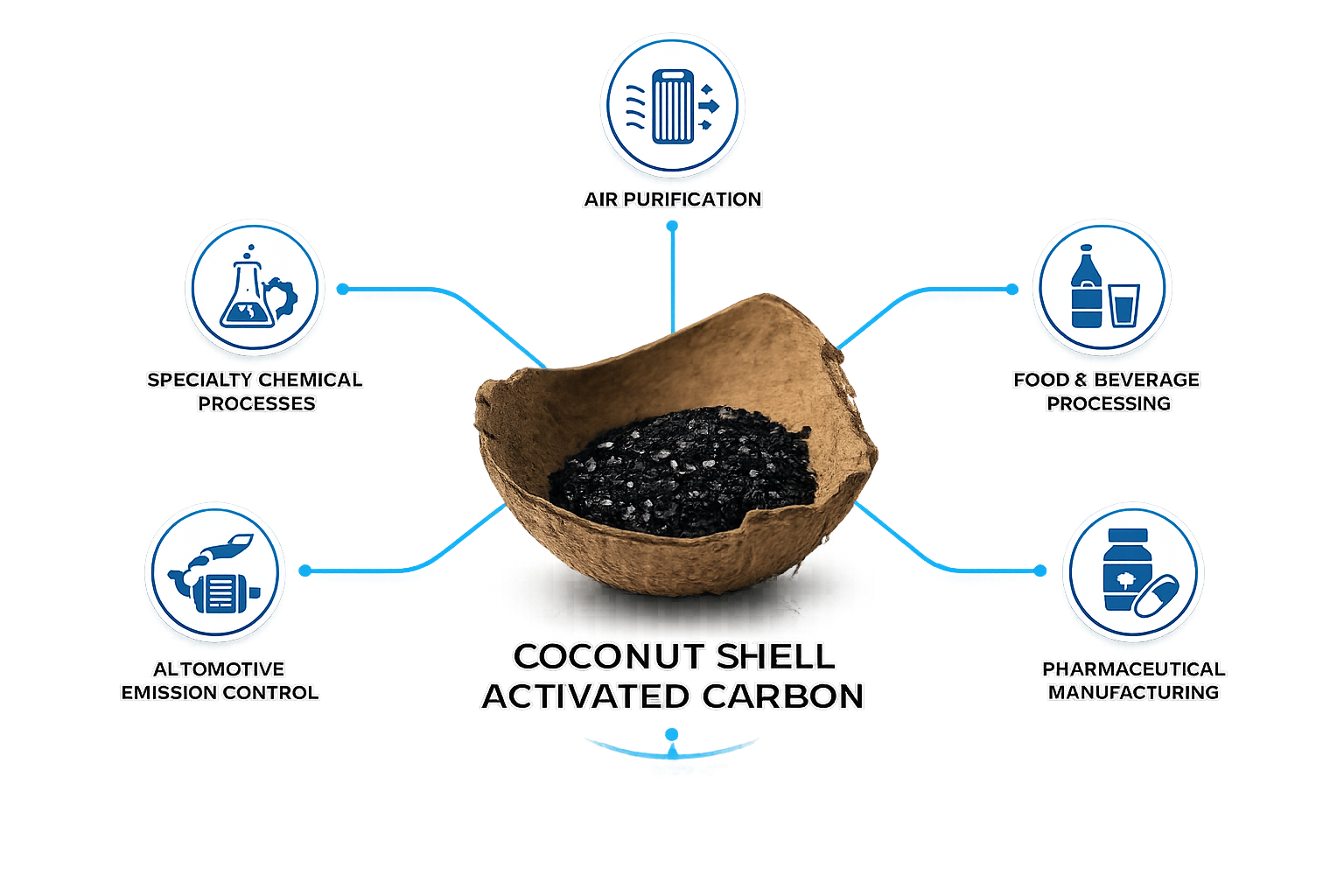
India has become an important manufacturing and supply base for Coconut Shell Activated Carbon used across water treatment, air and gas purification, gold recovery, chemical processing, food and beverage purification, pharmaceutical processing and industrial filtration.
A reliable Coconut Shell Activated Carbon Manufacturer India must do more than simply supply carbon. Industrial buyers require consistent product quality, controlled particle size, suitable adsorption characteristics, dependable mechanical strength, application-specific grades and reliable supply capability.
Carbure Activated Carbon manufactures high-performance Steam Activated Carbon from premium Coconut Charcoal. During activation, Coconut Charcoal faces superheated steam at 1000°C, developing an extensive pore network that provides the adsorption characteristics required for demanding purification applications.
Depending on the application, Coconut Shell Activated Carbon can be produced and supplied in granular, powdered and pelletized forms, with technical properties selected according to contaminant characteristics, treatment-system design and operating requirements.
Why Choose a Coconut Shell Activated Carbon Manufacturer in India?
India has an established coconut-processing sector and Activated Carbon manufacturing ecosystem, making it an important source of coconut-based carbon products for domestic and international industrial markets.
However, the country of manufacture alone does not determine Activated Carbon performance. Buyers should evaluate the manufacturer's raw material control, activation process, quality testing, product consistency, technical expertise and ability to support the intended application.
Key Advantages of Working with an Indian Manufacturer
- Access to coconut-based carbon raw materials
- Manufacturing capability for multiple Activated Carbon grades
- Granular, powdered and pelletized product options
- Supply capability for industrial and bulk requirements
- Support for domestic and export markets
- Application-specific technical guidance
- Flexible particle-size and performance specifications
For global buyers, consistent manufacturing and documented specifications are more important than geographical origin alone.
How Coconut Shell Activated Carbon Is Manufactured
The manufacturing process begins with suitable coconut shell-derived carbon material. Coconut shells are carbonized to produce Coconut Charcoal, which provides the carbon-rich structure required for activation.
During the activation stage, Coconut Charcoal faces superheated steam at 1000°C. Controlled activation develops and enlarges the internal pore network of the carbon, creating the high internal surface area required for adsorption.
The activated material is then processed according to the required product form and specification. Depending on customer requirements, the carbon may undergo crushing, screening, milling, pellet formation, washing, drying and quality testing.
Typical Manufacturing Stages
- Raw material selection
- Carbonization of coconut shells
- Production of Coconut Charcoal
- Controlled steam activation
- Particle sizing and screening
- Powdering or pellet preparation where required
- Optional washing or specialty treatment
- Drying and moisture control
- Technical quality testing
- Packing and dispatch
The exact manufacturing route varies according to product type, target specification and intended application.
Coconut Shell Activated Carbon Products
A professional Coconut Shell Activated Carbon Manufacturer in India should be capable of supplying different product forms for different purification systems.
| Product Type | Typical Applications |
|---|---|
| Granular Activated Carbon (GAC) | Water treatment, wastewater polishing, gold recovery, process purification and fixed-bed filtration |
| Powdered Activated Carbon (PAC) | Liquid-phase treatment, process purification, color reduction and batch treatment applications |
| Pelletized Activated Carbon | Air and gas purification, VOC treatment, odor control and gas-phase adsorption systems |
| Acid-Washed Activated Carbon | Selected high-purity water, chemical, food and pharmaceutical applications subject to grade specification |
| Impregnated Activated Carbon | Selected contaminant-specific air and gas purification applications |
The correct product form depends on whether the process is liquid-phase or gas-phase, the target contaminant, system design, contact time, pressure drop and required treatment performance.
Applications of Coconut Shell Activated Carbon
Coconut Shell Activated Carbon is widely used because its pore structure and mechanical characteristics can make it suitable for many demanding purification applications.
1. Water Treatment
Granular Coconut Shell Activated Carbon is commonly used in drinking water, municipal water, process water and industrial water treatment systems.
- Chlorine reduction
- Taste and odor control
- Selected dissolved organic contaminant adsorption
- VOC reduction
- Process water polishing
- RO pre-treatment support
2. Wastewater Treatment
Activated Carbon can be used as a polishing medium after primary and biological treatment stages to adsorb selected residual organic contaminants and improve final water quality.
3. Gold Recovery
Coconut Shell Activated Carbon is widely used in gold recovery circuits because high-hardness grades can withstand repeated mechanical handling while adsorbing dissolved gold complexes from process solutions.
Typical gold recovery systems include:
- Carbon-in-Pulp (CIP)
- Carbon-in-Leach (CIL)
- Carbon-in-Column (CIC)
4. Air and Gas Purification
Selected granular and pelletized carbon grades can be used for adsorption of VOCs, odors and organic vapors from industrial air and gas streams.
5. Chemical Processing
Coconut Shell Activated Carbon can support purification, decolorization and removal of selected organic impurities from chemical process streams.
6. Food and Beverage Processing
Suitable grades may be used for process water purification, decolorization and treatment of selected food and beverage streams, subject to the required quality and regulatory specifications.
7. Pharmaceutical Processing
Selected grades may support pharmaceutical process purification where appropriate product purity, specification and process validation requirements are met.
8. Solvent Recovery and Industrial Filtration
Activated Carbon is also used in selected solvent recovery and industrial filtration applications for capturing organic vapors and process contaminants.
Benefits of Coconut Shell Activated Carbon
Coconut-derived Activated Carbon offers several characteristics that make it attractive for industrial purification.
- High mechanical strength: Helps reduce particle breakdown and fines generation in demanding systems.
- Developed micropore structure: Particularly useful for adsorption of many smaller organic molecules.
- Strong adsorption performance: Properly activated Coconut Charcoal provides an extensive internal pore network.
- Suitable for continuous filtration: Granular grades can be used in fixed-bed adsorption systems.
- Multiple product forms: Available as granular, powdered and pelletized carbon.
- Application versatility: Used in water, gold, air, gas, chemical and process purification applications.
- Renewable raw material source: Coconut shells are an agricultural by-product that can be converted into a high-value purification material.
- Good operational durability: High-hardness grades can perform well in systems involving backwashing or repeated handling.
Important Quality Parameters for Coconut Shell Activated Carbon
Industrial buyers should evaluate several technical properties before purchasing Activated Carbon. A single parameter cannot fully predict real-world adsorption performance.
Iodine Value
Iodine value is commonly used as an indicator of micropore development. It is useful for product characterization but should not be treated as a universal measure of performance against every contaminant.
Particle Size
Particle size affects adsorption kinetics, hydraulic performance, pressure drop and contact efficiency. The correct size should match the filtration system and required flow conditions.
Hardness
Hardness is especially important for gold recovery, backwashing and other applications where the carbon undergoes repeated physical movement.
Ash Content
Ash represents inorganic residues in the Activated Carbon. The acceptable level should be selected according to the application specification.
Moisture
Moisture influences storage, handling and the usable quantity of dry carbon supplied.
Pore Size Distribution
The distribution of micropores, mesopores and larger transport pores affects how molecules of different sizes enter and interact with the carbon structure.
Surface Area
Surface area provides useful information about the internal structure, but the accessibility and pore-size distribution of that surface are also important.
Apparent Density
Apparent density influences how much carbon can be loaded into a defined filter volume and may affect system capacity and operating design.
How to Select the Right Coconut Shell Activated Carbon Grade
Selecting Coconut Shell Activated Carbon should begin with the application rather than simply choosing the highest specification available.
1. Identify the Target Contaminant
Determine whether the carbon needs to adsorb VOCs, taste and odor compounds, dissolved organics, color bodies, gold complexes, chemical impurities or another target compound.
2. Determine the Treatment Phase
Identify whether the carbon will be used in a liquid-phase or gas-phase application. This can influence the preferred product form, particle size and pore structure.
3. Select the Appropriate Product Form
Choose between Granular Activated Carbon, Powdered Activated Carbon or Pelletized Activated Carbon according to the treatment system.
4. Evaluate Pore Structure
The molecular size and characteristics of the target contaminant should match the available pore structure of the carbon.
5. Consider Particle Size
Smaller particles can provide faster adsorption kinetics but may increase pressure drop. Larger particles generally allow easier flow but may require greater contact time.
6. Check Mechanical Strength
Applications involving carbon movement, backwashing or repeated processing should use grades with suitable hardness and abrasion resistance.
7. Consider Purity Requirements
Water, food, pharmaceutical and other sensitive applications may require tighter control over ash, extractables and other grade-specific parameters.
8. Evaluate Contact Time and Flow Rate
Good Activated Carbon performance requires adequate interaction between the treatment stream and the carbon bed. High flow or inadequate bed depth can lead to early breakthrough.
9. Consider Operating Conditions
Temperature, pH, humidity, water chemistry, competing contaminants and concentration can all affect Activated Carbon performance.
10. Test Before Final Selection
Laboratory or pilot testing is recommended for technically demanding applications, mixed contaminants or processes with strict performance requirements.
How to Choose a Coconut Shell Activated Carbon Manufacturer in India
Choosing the right manufacturer can directly affect purification performance, carbon consumption, operating cost and system reliability.
1. Check Manufacturing Capability
The supplier should have controlled manufacturing processes for carbonization, activation, particle sizing, treatment and quality testing.
2. Evaluate Raw Material Quality
Consistent Coconut Charcoal quality is important because changes in raw material can influence pore development, hardness and final Activated Carbon characteristics.
3. Review Technical Specifications
Ask for relevant specifications such as particle size, iodine value, hardness, moisture, ash, apparent density and other application-specific parameters.
4. Look for Application Knowledge
A technical manufacturer should understand that different industries require different carbon grades and should help match the product to the actual contaminant and process.
5. Check Quality Consistency
Repeatability between batches is essential, especially for continuous industrial treatment systems.
6. Consider Supply Capacity
The manufacturer should be capable of supporting required volumes, packaging requirements and delivery schedules.
7. Evaluate Export Capability
For international customers, suitable documentation, packaging, logistics coordination and specification consistency are important parts of the supply relationship.
8. Review Certifications and Quality Systems
Relevant certifications and documented quality systems can help buyers evaluate manufacturing controls and supplier reliability. Product suitability should still be confirmed against the requirements of the intended application.
Carbure - Coconut Shell Activated Carbon Manufacturer India
Carbure Activated Carbon manufactures high-performance Activated Carbon from premium Coconut Charcoal for industrial purification applications in India and global markets.
Our Steam Activated Carbon production uses controlled activation technology in which Coconut Charcoal faces superheated steam at 1000°C to develop the internal pore network required for adsorption.
Carbure supplies different Activated Carbon grades and product forms for applications including:
- Drinking water treatment
- Industrial process water
- Wastewater purification
- Gold recovery
- Air and gas filtration
- VOC adsorption
- Odor control
- Chemical purification
- Food and beverage processing
- Selected pharmaceutical applications
- Industrial filtration
Our focus is on consistent product quality, technical specifications, application-based grade selection and dependable supply for domestic and international requirements.
Customers can share their target contaminant, application, required particle size, operating conditions and performance objectives with Carbure for suitable grade recommendations.
Sustainable Value of Coconut Shell Activated Carbon
Coconut shells are an agricultural by-product that can be converted into a valuable purification material instead of being treated only as waste.
Through carbonization and steam activation, Coconut Charcoal is transformed into a high-value industrial adsorbent used to support cleaner water, cleaner process streams and improved industrial purification.
The renewable nature of coconut shell feedstock makes it an attractive raw material for organizations seeking effective purification solutions while also considering resource efficiency and circular use of agricultural materials.
Coconut Shell Activated Carbon Manufacturer India - Final Thoughts
Selecting the right Coconut Shell Activated Carbon Manufacturer India requires evaluating much more than price or a single product specification.
Buyers should consider raw material quality, activation technology, pore structure, particle size, hardness, ash level, manufacturing consistency, application knowledge, testing capability and supply reliability.
Coconut Shell Activated Carbon provides a strong combination of adsorption performance, mechanical durability and application versatility for water treatment, gold recovery, air purification, chemical processing and other industrial purification requirements.
By selecting the correct carbon grade for the actual contaminant and operating conditions, industries can improve treatment efficiency, extend carbon service life and achieve more consistent purification performance.
FAQs
Coconut Shell Activated Carbon is a porous adsorption material manufactured from Coconut Charcoal through controlled steam activation. It is used in water treatment, gold recovery, air and gas purification, chemical processing and many other industrial applications.
India has established coconut-based raw material availability and Activated Carbon manufacturing capability. Buyers should select an Indian manufacturer based on quality consistency, technical specifications, application expertise and reliable supply rather than geographical location alone.
Coconut Shell Activated Carbon is available in Granular Activated Carbon, Powdered Activated Carbon, Pelletized Activated Carbon and selected specialty grades depending on the application and required specification.
Coconut Shell Activated Carbon is used in water treatment, wastewater purification, gold recovery, air and gas filtration, chemical processing, food and beverage purification, selected pharmaceutical processes and industrial filtration systems.
Coconut shells are carbonized to produce Coconut Charcoal. During activation, Coconut Charcoal faces superheated steam at 1000°C, developing the internal pore structure required for adsorption.
Select the grade according to the target contaminant, treatment phase, pore structure, particle size, iodine value, hardness, ash content, flow rate, contact time and operating conditions.
No. Iodine value is an important product-characterization parameter, but actual adsorption performance also depends on pore structure, contaminant characteristics, particle size, contact time and process conditions.
Coconut Charcoal can provide high mechanical strength and strong micropore development after controlled steam activation, making it suitable for many demanding adsorption and purification applications.
Looking for a Coconut Shell Activated Carbon Manufacturer in India?
Carbure Activated Carbon manufactures high-performance Steam Activated Carbon from premium Coconut Charcoal for water treatment, wastewater purification, gold recovery, air and gas filtration, chemical processing and other industrial purification requirements.
Contact Carbure Activated Carbon for suitable grades, technical specifications, application support, bulk supply and export requirements.
