
What Are Activated Carbon Cigarette Filters?
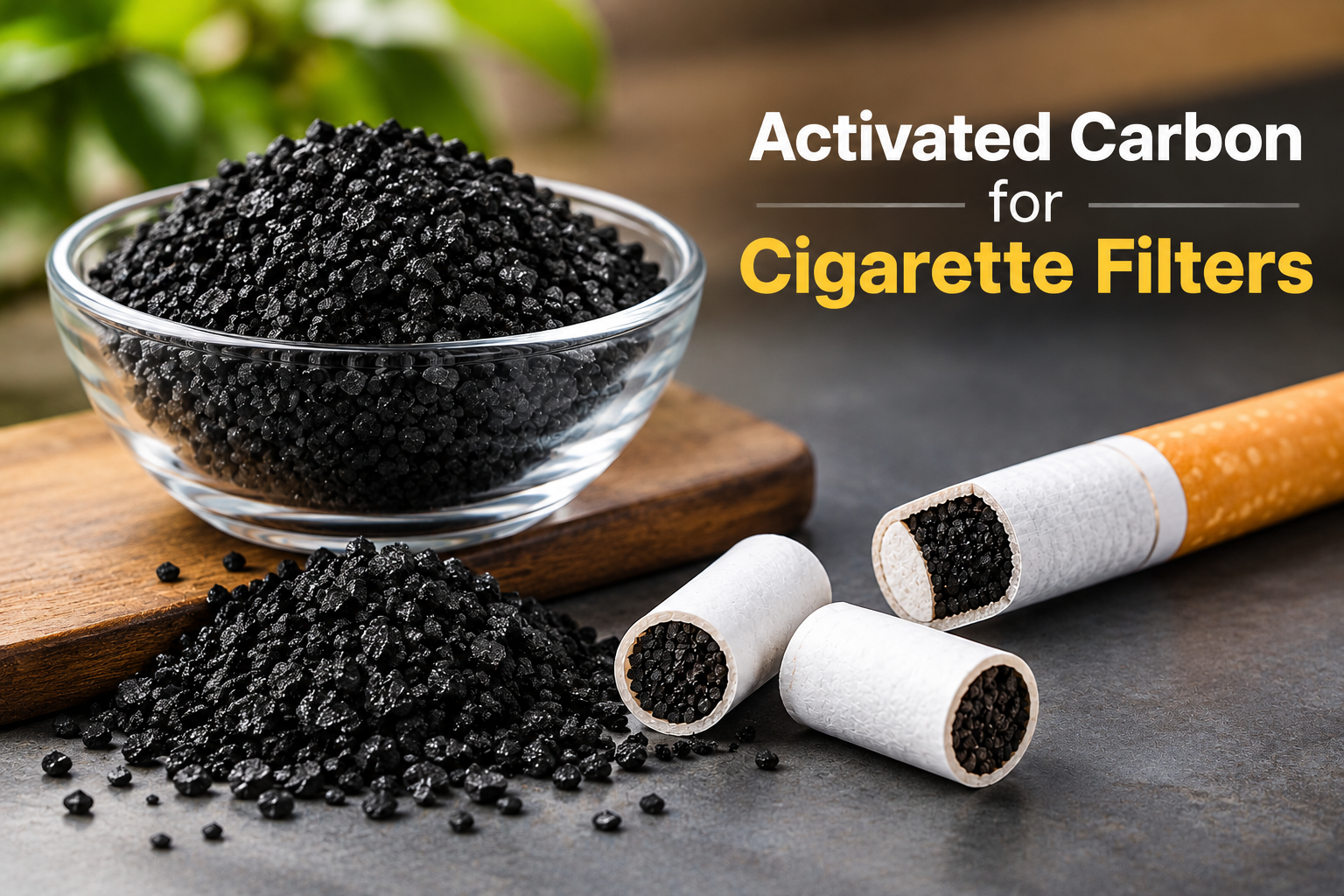
Cigarette Filters are components positioned at the mouth end of cigarettes and manufactured using different filtration materials. Certain filter designs incorporate Activated Carbon, also known as Activated Charcoal, to adsorb selected gaseous and vapour-phase constituents present in cigarette smoke.
Activated Carbon contains a highly developed internal pore structure that provides a large surface area for adsorption. When incorporated into a cigarette filter, the carbon comes into contact with smoke passing through the filtration section and can retain certain chemical constituents through interactions with its internal surfaces.
Coconut shell-based Activated Carbon is one of the materials considered for this application because suitable grades can provide developed microporosity, controlled particle size and adsorption characteristics relevant to vapour-phase filtration.
Activated Carbon can be incorporated into different filter constructions, including carbon-filled cavities, combined cellulose acetate and carbon filters, and other specialised multi-segment arrangements.
The performance of Activated Carbon in Cigarette Filters depends on carbon characteristics, filter design, contact time, smoke composition, moisture and testing conditions. The removal of selected constituents does not mean that cigarette smoke becomes harmless.
Why Is Activated Carbon Used in Cigarette Filters?
Activated Carbon for Cigarette Filters is used because its porous structure provides adsorption sites for certain volatile compounds present in cigarette smoke.
Conventional fibrous filter materials and Activated Carbon perform different filtration functions. While fibrous materials are commonly used to retain part of the smoke particulate matter, Activated Carbon can adsorb selected molecules present in the vapour phase.
The combination of different filtration materials allows manufacturers to investigate the behaviour of particular smoke constituents under controlled testing conditions.
The key technical functions of Activated Carbon in Cigarette Filters include:
- Adsorption of selected vapour-phase organic compounds.
- Providing additional adsorption sites within a filter structure.
- Supporting experimental evaluation of vapour-phase filtration.
- Allowing combination with cellulose acetate filtration materials.
- Providing application-specific carbon particle size options.
- Supporting different carbon-containing filter configurations.
- Enabling measurement of adsorption behaviour under defined laboratory conditions.
Actual adsorption efficiency varies depending on the compound being measured and the operating conditions of the filter. Activated Carbon does not remove every hazardous substance found in cigarette smoke.
How Do Activated Carbon Cigarette Filters Work?
Cigarette Filters containing Activated Carbon combine physical filter construction with the adsorption properties of porous carbon materials.
The following stages explain the general working mechanism of carbon-containing cigarette filters.
Step 1 - Preparation of Activated Carbon
Coconut Charcoal can be used as a raw material for producing coconut shell-based Steam Activated Carbon.
During the physical activation process, Coconut Charcoal is exposed to superheated steam at 1000°C under controlled industrial conditions to develop the internal pore network.
Step 2 - Particle Size Classification
After activation, the carbon is processed and classified into appropriate particle size ranges.
For cigarette filter applications, particle size distribution is an important consideration because it influences handling characteristics, carbon distribution and accessibility of adsorption sites.
Step 3 - Incorporation into Filter Material
Activated Carbon may be placed inside a dedicated filter cavity or incorporated into a fibrous filtration structure, depending on the manufacturer's filter design.
Some filter constructions use multiple segments that combine cellulose acetate and carbon-containing sections.
Step 4 - Smoke Contact with Activated Carbon
As cigarette smoke passes through the filter, vapour-phase compounds come into contact with exposed Activated Carbon surfaces.
Certain compounds may diffuse into accessible carbon pores and become adsorbed on the internal surfaces.
Step 5 - Adsorption of Selected Compounds
The extent of adsorption depends on the molecular properties of the compound, pore characteristics, available carbon surface, moisture and residence time.
Not all smoke constituents are adsorbed to the same extent. Some compounds may pass through the filter without significant adsorption.
Step 6 - Laboratory Performance Evaluation
Carbon-containing filters can be evaluated using appropriate laboratory methods to measure selected smoke constituents before and after filtration.
Testing helps determine how a particular Activated Carbon grade performs in a specific filter configuration.
Adsorption Mechanism of Activated Carbon in Cigarette Filters
The main technical function of Activated Carbon in Cigarette Filters is the adsorption of selected gaseous and vapour-phase substances.
Activated Carbon contains numerous pores of different sizes. These pores provide internal surfaces where certain molecules can be retained through physical adsorption.
1. Movement of Vapour-Phase Molecules
As smoke travels through the carbon-containing filter section, gaseous molecules move through the spaces around the carbon particles.
2. Contact with Carbon Surfaces
Some vapour-phase molecules reach the external surfaces of Activated Carbon particles and enter accessible pore openings.
3. Diffusion into Carbon Pores
Suitable molecules may diffuse through the internal pore network of Activated Carbon.
Pore accessibility is important because molecules must reach available adsorption sites within the short contact time associated with cigarette smoke filtration.
4. Adsorption onto Internal Surfaces
Certain molecules are retained on carbon surfaces through intermolecular interactions.
The strength of these interactions varies depending on the physical and chemical characteristics of the compounds and the carbon surface.
5. Development of Adsorption Loading
As more compounds are adsorbed, a portion of the available carbon adsorption capacity becomes occupied.
The adsorption behaviour depends on the available surface area, pore structure, competing substances and smoke composition.
6. Breakthrough of Non-Adsorbed Compounds
Some compounds may pass through without adsorption, while others may break through when adsorption sites are insufficient or contact time is limited.
Therefore, laboratory results for one compound cannot automatically be used to predict the filtration behaviour of every smoke constituent.
Important Activated Carbon Properties for Cigarette Filters
Selecting Activated Carbon for Cigarette Filters requires careful evaluation of physical characteristics, adsorption performance and filter manufacturing requirements.
1. Specific Surface Area
Activated Carbon is known for its extensive internal surface area, which can range from approximately 600 to 2000 m²/g across different commercial grades.
Surface area provides an indication of the developed pore network, but it does not independently determine adsorption performance for every vapour-phase compound.
2. Micropore Structure
Micropores provide adsorption sites for certain small molecules.
The distribution of micropores and their accessibility can influence adsorption behaviour under the short contact times associated with Cigarette Filters.
3. Particle Size Distribution
Particle size affects how Activated Carbon can be incorporated and distributed within filter components.
The required size range depends on the filter manufacturing process and the intended carbon-containing filter construction.
4. Dust and Fine Particle Content
Dust generation is an important physical quality consideration for carbon used in filter production.
Controlled fine particle content can support cleaner industrial handling and more consistent processing.
5. Moisture Content
Moisture may influence the adsorption of certain organic vapours because water can compete for adsorption sites or affect access to the pore network.
Moisture specifications should therefore be evaluated according to the intended application and storage conditions.
6. Ash Content
Ash represents the mineral residue associated with Activated Carbon.
The acceptable ash level depends on the manufacturer's material specifications and quality requirements.
7. Adsorption Activity
Adsorption activity indicates how a particular carbon grade performs against a specified test substance under defined conditions.
Application-specific vapour adsorption testing is more informative than relying on a single general adsorption index.
8. Purity and Material Consistency
Consistent material quality is important when Activated Carbon is supplied for a controlled manufacturing process.
Manufacturers may assess impurities, particle size distribution, moisture and other relevant parameters before approving a carbon grade.
Coconut Shell Activated Carbon for Cigarette Filters
Coconut Shell Activated Carbon is widely recognised as a porous adsorption material used in several gas-phase and liquid-phase industrial applications.
For Cigarette Filters, selected coconut shell-based carbon grades may be evaluated for their pore structure, adsorption properties, particle size distribution and handling characteristics.
At Carbure Activated Carbon Pvt. Ltd., India, Coconut Charcoal is processed through physical activation using superheated steam at 1000°C to produce Steam Activated Carbon.
This activation process develops a porous carbon structure that can be further processed and classified for application-specific industrial requirements.
The important characteristics to consider when evaluating coconut shell Activated Carbon for Cigarette Filters include:
- Developed internal adsorption surface area.
- Micropore structure and pore accessibility.
- Vapour-phase adsorption characteristics.
- Controlled granular particle size distribution.
- Acceptable dust and fine particle content.
- Moisture and ash specifications.
- Mechanical integrity during handling.
- Consistency between production batches.
- Compatibility with the intended filter construction.
- Performance in representative application testing.
The suitability of a specific Carbure Activated Carbon grade for cigarette filter applications should be established through technical specification review, customer qualification and appropriate laboratory testing.
Factors Affecting Activated Carbon Performance in Cigarette Filters
Activated Carbon performance in Cigarette Filters is influenced by several interconnected factors.
Understanding these factors is important when comparing carbon grades or evaluating different filter configurations.
- Carbon pore structure: Determines the range of pores available for adsorption of suitable molecules.
- Available surface area: Provides adsorption sites, although surface area alone does not predict the removal of individual compounds.
- Carbon particle size: Influences carbon distribution, handling and access to adsorption surfaces.
- Carbon loading: The quantity of Activated Carbon incorporated into the filter affects the amount of adsorption material available.
- Contact time: Short smoke residence times can limit the opportunity for molecules to diffuse into carbon pores.
- Smoke composition: Different vapour-phase substances have different adsorption characteristics.
- Moisture: Water vapour can affect adsorption by competing for adsorption sites or changing pore accessibility.
- Filter configuration: Carbon placement and filter segment design influence the contact between smoke and Activated Carbon.
- Airflow conditions: Flow characteristics can influence how smoke moves through the carbon-containing section.
- Competing compounds: Multiple molecules can compete for adsorption sites inside the carbon pores.
- Carbon quality: Consistency in moisture, ash, dust and particle size supports reliable material qualification.
- Testing conditions: Differences in testing protocols may produce different measured adsorption results.
A carbon grade showing high adsorption activity in one laboratory test may not perform identically in another filter construction.
Application-specific testing is therefore important for evaluating real filtration behaviour under defined conditions.
Activated Carbon Cigarette Filters vs Conventional Cigarette Filters
Conventional cigarette filters and Activated Carbon-containing filters differ in their materials and filtration mechanisms.
Many conventional filters rely primarily on fibrous materials such as cellulose acetate, while certain specialised filters incorporate Activated Carbon to provide adsorption sites for selected vapour-phase compounds.
| Parameter | Conventional Fibrous Filter | Activated Carbon-Containing Filter |
|---|---|---|
| Primary material | Commonly cellulose acetate | Activated Carbon combined with supporting filter materials |
| Main filtration mechanism | Primarily physical retention of some smoke particles | Physical filtration combined with adsorption of selected vapour-phase compounds |
| Carbon pore adsorption | Generally not present as a dedicated carbon function | Available through porous Activated Carbon |
| Filter construction | Commonly fibrous filter structure | May include carbon cavities or multiple segments |
| Material selection | Fibrous material properties | Carbon characteristics and supporting filter materials |
| Vapour-phase behaviour | Depends on the material and constituent | May adsorb selected constituents under defined conditions |
| Health risk elimination | Does not make smoking safe | Does not make smoking safe |
Activated Carbon-containing filters provide an additional adsorption mechanism, but measured reductions in selected smoke constituents should not be interpreted as proof of reduced disease risk.
Neither conventional filters nor carbon-containing filters eliminate the serious health risks associated with cigarette smoking.
Common Challenges in Activated Carbon Cigarette Filter Applications
1. Limited Contact Time
Smoke passes through a cigarette filter over a short period, which can limit the time available for vapour-phase molecules to reach internal adsorption sites.
Carbon pore accessibility and filter configuration should be considered when evaluating adsorption performance.
2. Variation in Smoke Composition
Cigarette smoke contains a complex mixture of gases, vapours and particles.
Different compounds respond differently to Activated Carbon adsorption, and the reduction of one compound does not establish the removal of others.
3. Moisture Interference
Water vapour can influence the adsorption behaviour of carbon materials.
Moisture-related effects should be considered during carbon selection and application testing.
4. Carbon Dust Generation
Handling and processing granular Activated Carbon can generate fine particles.
Appropriate particle size specifications and quality control are important for industrial filter manufacturing.
5. Inconsistent Particle Size
A broad particle size distribution can affect carbon packing, handling and consistency within the filter structure.
Suitable classification and quality control help maintain the required material characteristics.
6. Limited Adsorption Capacity
Activated Carbon provides a finite number of adsorption sites.
The available capacity can be influenced by the carbon quantity, competing compounds and test conditions.
7. Interpreting Filtration Results
Results from standardised laboratory tests may not directly represent every real-world smoking condition.
Any performance claim must identify the measured substances, test method and conditions under which the result was obtained.
How to Select Activated Carbon for Cigarette Filters
Selecting suitable Activated Carbon for Cigarette Filters involves comparing adsorption characteristics with the physical requirements of the filter manufacturing process.
1. Identify the Application Requirements
Determine the intended filter construction, carbon incorporation method and the material specifications required for production.
2. Evaluate Adsorption Characteristics
Review carbon adsorption performance using representative vapour-phase compounds and appropriate test methods.
3. Examine the Pore Structure
Consider micropore characteristics and pore accessibility in relation to the molecules being evaluated.
4. Select the Required Particle Size
Choose carbon particle sizes that are compatible with the intended filter manufacturing and material handling equipment.
5. Review Dust Content
Evaluate dust and fine particle specifications to determine whether the grade satisfies manufacturing quality requirements.
6. Check Moisture and Ash Content
Review moisture, ash and other applicable material quality parameters.
7. Assess Consistency
Consistent physical characteristics and adsorption properties are important when a carbon grade is used in repeat manufacturing operations.
8. Verify Material Documentation
Request the applicable technical data sheet, quality specifications and other documentation relevant to product qualification.
9. Conduct Representative Testing
Perform laboratory evaluation using the actual filter construction or an appropriately representative test arrangement.
Carbon performance should be compared using consistent methods and clearly identified evaluation criteria.
Why Choose Carbure Activated Carbon for Cigarette Filter Applications?
Carbure Activated Carbon Pvt. Ltd., Coimbatore, India, manufactures coconut shell-based Activated Carbon for industrial adsorption and purification applications.
Using Coconut Charcoal and Steam Activation technology, Carbure develops Activated Carbon products with porous structures suitable for evaluation across different adsorption applications.
For customers evaluating carbon materials for Cigarette Filters, Carbure Activated Carbon can discuss product specifications and application requirements to help identify grades for further technical assessment.
Important product considerations include:
- Coconut shell-based Steam Activated Carbon.
- Developed pore structures for adsorption applications.
- Application-specific carbon grade selection.
- Granular Activated Carbon particle size requirements.
- Adsorption activity and surface area characteristics.
- Moisture, ash and dust specifications.
- Carbon material quality and consistency.
- Technical discussions for industrial requirements.
- Bulk supply enquiries and specification review.
Carbure Activated Carbon operates with quality management and industrial manufacturing systems relevant to its Activated Carbon production activities.
Any grade proposed for cigarette filter use must be separately assessed against the customer's application-specific material requirements, regulatory obligations and testing specifications.
Customers can contact Carbure Activated Carbon to request available technical specifications and discuss whether a suitable carbon grade can be offered for their intended filter application.
Cigarette Filters - Final Thoughts
Cigarette Filters containing Activated Carbon use the adsorption characteristics of porous carbon materials to retain selected vapour-phase smoke constituents under specific conditions.
Coconut shell-based Steam Activated Carbon is a material that may be evaluated for this application because selected grades can provide developed porosity, controlled particle size and useful physical characteristics.
Important factors affecting Activated Carbon performance include pore structure, particle size, carbon quantity, moisture, contact time, filter construction and the substances being measured.
Selection should be based on material specifications, representative laboratory testing and suitability for the intended manufacturing process.
Although Activated Carbon can adsorb certain chemical constituents, carbon-containing Cigarette Filters do not remove every harmful smoke substance and do not make cigarette smoking safe.
For industrial customers seeking coconut shell-based Activated Carbon, Carbure Activated Carbon, India, offers technical discussions and product specification reviews to support application-specific material evaluation.
Frequently Asked Questions About Cigarette Filters
Activated Carbon is incorporated into certain Cigarette Filters to adsorb selected gaseous and vapour-phase compounds present in cigarette smoke under defined testing conditions. It does not eliminate the health risks of smoking.
Activated Carbon contains a porous internal structure that provides adsorption sites. Certain vapour-phase molecules can enter accessible pores and become retained on the carbon surfaces as smoke passes through the filter.
Selected Coconut Shell Activated Carbon grades provide developed microporosity and can be classified according to required particle sizes. Their suitability depends on the intended filter design, adsorption requirements and quality specifications.
Certain filter designs use granular Activated Carbon in a filter cavity or combined with fibrous materials. Grade selection depends on particle size, dust content, adsorption characteristics and manufacturing requirements.
No. Activated Carbon may reduce selected vapour-phase constituents under specified conditions, but it cannot remove all harmful compounds from cigarette smoke. Activated Carbon-containing filters do not make cigarette smoking safe.
Important properties include pore structure, surface area, adsorption activity, particle size distribution, dust content, moisture, ash content and consistency of material quality.
Yes. Certain Cigarette Filter designs combine Activated Carbon with cellulose acetate or other supporting filtration materials in multi-segment or carbon-containing filter structures.
Manufacturers review carbon adsorption performance, particle size, pore structure, dust, moisture and other quality parameters. Representative testing and regulatory compliance checks are important before a carbon grade is approved for use.
Looking for Activated Carbon for Cigarette Filters?
Carbure Activated Carbon manufactures coconut shell-based Activated Carbon in India for industrial adsorption and purification applications. Our team can discuss available carbon grades and relevant physical and adsorption specifications for customers evaluating Activated Carbon for Cigarette Filters.
Share your required Activated Carbon particle size, adsorption parameters, moisture specifications, dust limits, bulk quantity and intended filter manufacturing requirements with Carbure Activated Carbon. Contact our team for technical specification review and product enquiries.
