
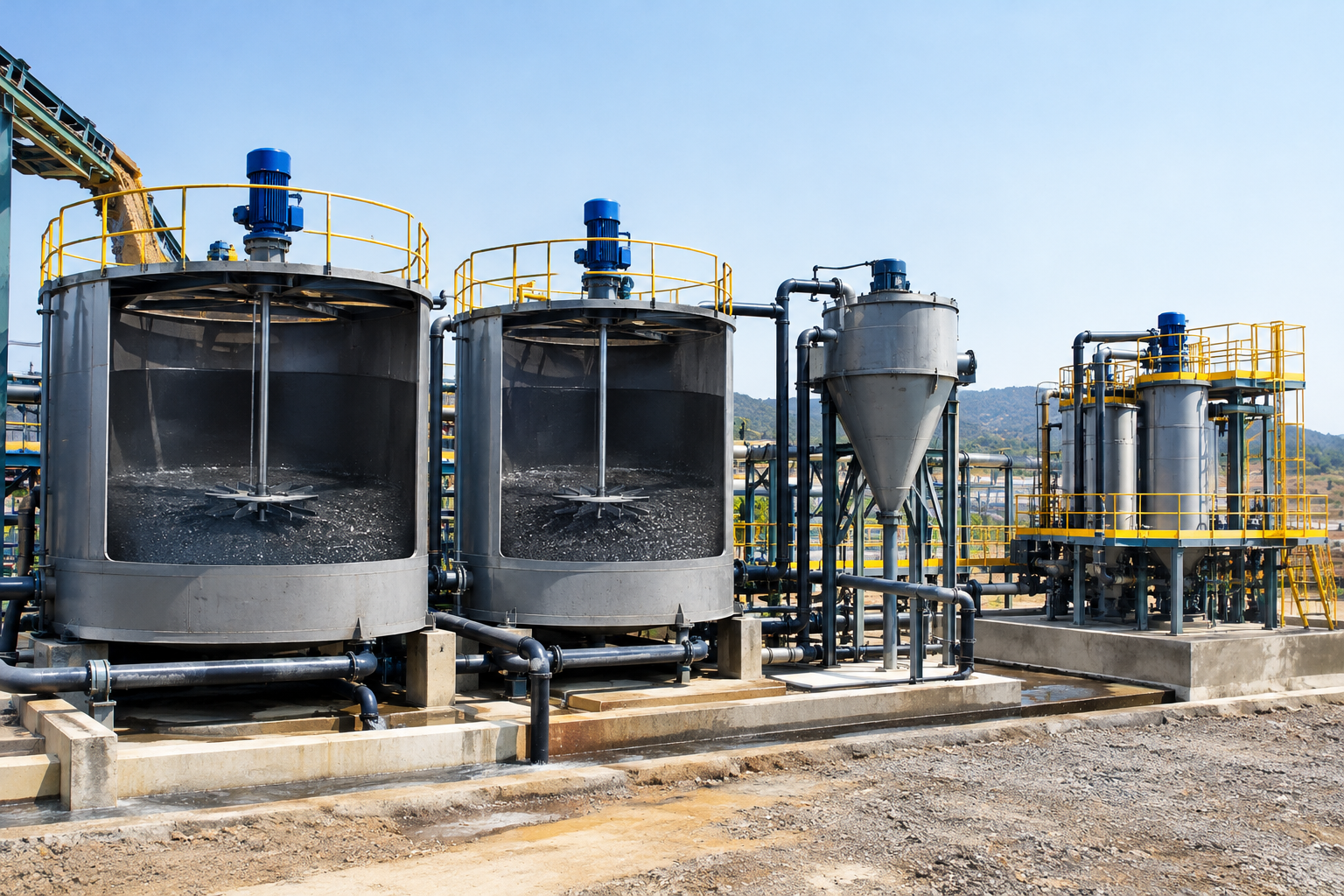
What Are Carbon-in-Pulp (CIP) Circuits?
Carbon-in-Pulp (CIP) circuits are widely used in gold processing operations to recover dissolved gold from cyanide-leached ore slurry using granular Activated Carbon. The process uses the adsorption properties of Activated Carbon to concentrate dissolved gold onto carbon particles, allowing subsequent gold recovery through elution and downstream processing.
In a conventional CIP gold recovery process, the ore is first treated in a leaching circuit where gold is dissolved into solution. The leached slurry then passes through a series of adsorption tanks containing Activated Carbon.
Within these tanks, dissolved gold-cyanide complexes are adsorbed onto the highly developed internal pore surfaces of the carbon. The loaded carbon is subsequently separated from the slurry and processed to recover the adsorbed gold.
Successful operation depends on the interaction between ore characteristics, leaching conditions, Activated Carbon properties, adsorption efficiency, carbon movement and overall circuit design.
Why Is Activated Carbon Used in CIP Gold Recovery?
Activated Carbon plays a central role in the recovery of dissolved gold from cyanide leach solutions. Its extensive internal pore structure provides adsorption sites capable of retaining gold-cyanide complexes under suitable process conditions.
Granular coconut shell-based Activated Carbon is commonly selected for gold recovery applications because appropriate grades can combine useful adsorption characteristics with mechanical strength.
In Carbon-in-Pulp (CIP) circuits, Activated Carbon supports:
- Adsorption of dissolved gold-cyanide complexes from leached slurry
- Concentration of dissolved gold onto recoverable carbon particles
- Separation of gold-bearing carbon from ore slurry
- Transfer of loaded carbon to elution and downstream recovery systems
- Repeated carbon use through appropriate elution and regeneration
- Controlled gold recovery through multi-stage adsorption circuits
- Reduction of soluble gold losses when circuit conditions are properly managed
The most suitable Activated Carbon must provide consistent performance under the actual operating conditions of the gold processing plant.
How Do Carbon-in-Pulp (CIP) Circuits Work?
A typical Carbon-in-Pulp process consists of several connected stages, beginning with gold leaching and continuing through carbon adsorption, loaded carbon recovery, elution and regeneration.
Step 1 - Ore Preparation and Gold Leaching
Gold-bearing ore is crushed and ground to achieve the required liberation. In the leaching stage, gold is dissolved into solution using a controlled cyanide leaching process under appropriate metallurgical conditions.
The slurry leaving the leaching section contains dissolved gold that can subsequently be recovered through carbon adsorption.
Step 2 - Slurry Transfer to CIP Adsorption Tanks
The leached slurry enters a series of agitated adsorption tanks containing Granular Activated Carbon.
Each tank is designed to maintain suitable contact between the slurry and carbon while retaining carbon particles through screening arrangements.
Step 3 - Gold Adsorption onto Activated Carbon
During contact, dissolved gold-cyanide complexes move from the solution toward the carbon surface and into accessible pores, where adsorption occurs.
The rate and extent of adsorption depend on the selected carbon grade, dissolved gold concentration, solution chemistry, contact conditions and available adsorption sites.
Step 4 - Counter-Current Carbon Movement
Many CIP circuits operate with slurry moving through the adsorption tanks in one direction while Activated Carbon is transferred between tanks in the opposite direction.
This arrangement helps expose relatively fresh carbon to progressively lower dissolved gold concentrations and allows carbon closer to the slurry inlet to develop a higher gold loading.
Step 5 - Loaded Carbon Recovery
Gold-loaded carbon is separated from the slurry using suitable screens and transferred to the elution section.
Efficient screening is important because the loss of fine, gold-bearing carbon can contribute to unrecovered gold.
Step 6 - Elution and Gold Recovery
In the elution stage, gold is desorbed from the loaded Activated Carbon using a suitable industrial stripping system.
The resulting gold-bearing solution is then processed through downstream recovery operations, which may include electrowinning and smelting.
Step 7 - Activated Carbon Regeneration and Reuse
After elution, the carbon may undergo regeneration to restore adsorption activity affected by fouling and repeated operation.
Carbon that satisfies the plant's physical and adsorption quality requirements can then be returned to the CIP circuit.
Gold Adsorption Mechanism in Carbon-in-Pulp (CIP) Circuits
The primary function of Activated Carbon in CIP circuits is the adsorption of dissolved gold-cyanide complexes from the liquid phase of the ore slurry.
Activated Carbon contains a highly developed internal pore network that provides extensive surface area for the adsorption of suitable dissolved species.
1. Transport of Dissolved Gold
Dissolved gold species are transported from the bulk solution toward the external surface of the Activated Carbon particles.
2. Diffusion into the Pore Structure
The dissolved gold species move into accessible pores within the carbon. The available pore structure and diffusion characteristics influence the adsorption rate.
3. Adsorption onto Carbon Surfaces
Gold-cyanide complexes are retained through interactions with the internal carbon surfaces. The adsorption behavior is influenced by solution chemistry, including the presence of other dissolved constituents.
4. Development of Gold Loading
As adsorption continues, gold accumulates on the carbon. The loading achieved depends on operating conditions, competing species, available adsorption capacity and contact time.
5. Carbon Recovery and Elution
Once carbon reaches the desired loading condition, it is withdrawn for elution and downstream gold recovery.
Both adsorption kinetics and loading capacity are important when evaluating Activated Carbon for CIP applications.
Important Activated Carbon Properties for CIP Circuits
Choosing Activated Carbon for gold recovery requires consideration of several physical and adsorption characteristics.
1. Gold Adsorption Activity
Gold adsorption activity indicates how effectively Activated Carbon can adsorb gold from a representative solution under defined testing conditions.
High adsorption activity can support efficient dissolved gold recovery, but actual circuit performance must be verified through suitable testing.
2. Gold Loading Capacity
Loading capacity describes the amount of gold that carbon can retain under specified conditions. It is affected by pore structure, solution chemistry and competing adsorbed substances.
3. Carbon Hardness
Mechanical hardness is particularly important in continuously agitated adsorption tanks.
Carbon with suitable hardness and attrition resistance can better withstand handling, transfer and regeneration operations.
4. Attrition Resistance
Attrition can generate fine carbon particles during mixing and transport. When those particles contain adsorbed gold, their loss from the process may have economic consequences.
5. Particle Size Distribution
Particle size affects adsorption kinetics, carbon screening efficiency, hydraulic behavior and transfer characteristics.
The carbon size range must be compatible with the plant's interstage screens and operating requirements.
6. Pore Structure
An appropriate combination of pore accessibility and adsorption surface is important for gold adsorption.
Surface area alone does not determine gold recovery performance. Adsorption activity and loading behavior must also be evaluated.
7. Ash and Impurities
Ash content and other relevant carbon quality characteristics should be reviewed against the specifications required by the gold recovery operation.
8. Regeneration Performance
The ability of carbon to retain useful adsorption and mechanical properties after repeated elution and regeneration cycles affects long-term operating economics.
Choosing Coconut Shell Activated Carbon for CIP Gold Recovery
Coconut Shell Activated Carbon is widely used in gold recovery because appropriately manufactured grades can offer a combination of developed pore structure, hardness and resistance to mechanical degradation.
At Carbure Activated Carbon, Coconut Charcoal is processed through physical activation, where it is exposed to superheated steam at 1000°C to develop the porous structure of Steam Activated Carbon.
The resulting Activated Carbon can be manufactured and classified according to application-specific adsorption and physical requirements.
For Carbon-in-Pulp circuits, the evaluation of coconut shell-based Activated Carbon should consider:
- Gold adsorption activity under representative conditions
- Gold loading capacity
- Granular particle size distribution
- Mechanical hardness
- Attrition resistance and fine generation
- Ash and other relevant quality parameters
- Elution characteristics
- Regeneration performance
- Compatibility with existing screening and carbon handling equipment
Carbure Activated Carbon's gold recovery range includes GOLD CARB 60 and GOLD CARBURE 55. Current technical specifications and application suitability should be confirmed before product selection.
Factors Affecting Carbon-in-Pulp (CIP) Circuit Performance
The performance of Carbon-in-Pulp (CIP) circuits is influenced by both the characteristics of the Activated Carbon and the design and operation of the gold processing plant.
- Upstream leaching efficiency: Gold must be adequately dissolved before it can be recovered through carbon adsorption.
- Dissolved gold concentration: The available gold concentration influences adsorption loading and concentration gradients.
- Activated Carbon activity: Carbon adsorption characteristics affect the rate of gold uptake.
- Carbon inventory: Sufficient active carbon must be present to support the required adsorption duty.
- Slurry characteristics: Solids concentration, particle behavior and mixing influence carbon contact conditions.
- Residence time: Adequate contact is required for effective adsorption across the circuit.
- Solution chemistry: Cyanide concentration, pH, dissolved salts and competing substances can influence adsorption.
- Carbon fouling: Organic and inorganic substances may reduce accessible adsorption sites.
- Screen performance: Effective screening retains carbon within the circuit and helps minimize losses.
- Carbon transfer: Controlled carbon movement supports the required loading profile across adsorption stages.
- Elution and regeneration: Proper downstream treatment helps maintain useful carbon performance over repeated cycles.
- Mechanical degradation: Excessive attrition may increase carbon consumption and the risk of losing gold-bearing fines.
Plant operators should evaluate these factors together rather than attributing every recovery problem to Activated Carbon quality alone.
Carbon-in-Pulp (CIP) vs Carbon-in-Leach (CIL) Circuits
Carbon-in-Pulp (CIP) and Carbon-in-Leach (CIL) are established gold recovery processes that use Activated Carbon to adsorb dissolved gold.
The principal difference is how gold leaching and carbon adsorption are integrated within the process.
| Parameter | Carbon-in-Pulp (CIP) | Carbon-in-Leach (CIL) |
|---|---|---|
| Leaching stage | Generally completed before adsorption | Leaching and adsorption occur together or overlap |
| Carbon addition | Carbon is introduced after the separate leaching stage | Carbon is present during leaching |
| Adsorbent | Granular Activated Carbon | Granular Activated Carbon |
| Gold recovery mechanism | Adsorption of dissolved gold onto carbon | Adsorption of dissolved gold onto carbon |
| Process arrangement | Separate leaching and adsorption sections | Combined or overlapping leaching and adsorption duties |
| Carbon requirements | Suitable adsorption activity and mechanical properties | Suitable adsorption activity and mechanical properties |
Neither CIP nor CIL is universally superior. The preferred circuit depends on the ore characteristics, metallurgical test results, process requirements and overall plant economics.
Common CIP Circuit Challenges and Corrective Focus
1. Carbon Attrition and Fine Generation
Repeated agitation and mechanical handling can cause carbon breakage and generate fines.
Evaluate carbon hardness, transfer equipment, screening arrangements and handling practices to help minimize carbon losses.
2. Reduced Gold Adsorption Activity
Carbon fouling, competing substances and changes in solution chemistry can reduce adsorption performance.
Testing both fresh and regenerated carbon can help identify whether reduced carbon activity is contributing to lower recovery.
3. High Soluble Gold in Tailings
High soluble gold losses can result from incomplete adsorption or other circuit limitations.
Review upstream leaching performance, carbon inventory, carbon loading profiles, contact conditions, screen efficiency and carbon transfer before making process changes.
4. Excessive Carbon Consumption
High carbon make-up requirements may indicate mechanical degradation, handling losses or other operational issues.
Evaluating carbon consumption per operating cycle provides a more useful comparison than purchasing price alone.
5. Inconsistent Regeneration Performance
Incomplete elution, fouling or unsuitable regeneration conditions may reduce carbon activity over repeated cycles.
Regeneration procedures should be evaluated against plant-specific technical and safety requirements.
How to Select Activated Carbon for CIP Gold Recovery
Selecting the right Activated Carbon grade is essential for maintaining reliable gold adsorption, controlling carbon losses and supporting operating efficiency.
1. Understand the CIP Circuit Requirements
Identify the number of adsorption stages, slurry characteristics, dissolved gold concentration, carbon inventory and operating conditions.
2. Evaluate Gold Adsorption Activity
Compare carbon grades under representative testing conditions to understand gold adsorption kinetics and adsorption performance.
3. Review Gold Loading Capacity
Evaluate the carbon's ability to retain gold under the chemistry and loading conditions expected in the circuit.
4. Check Particle Size Compatibility
Select carbon with a particle size distribution compatible with the circuit's screens and carbon transfer arrangements.
5. Consider Hardness and Attrition Resistance
Choose a grade that can withstand the expected agitation, pumping, carbon handling and regeneration conditions.
6. Review Carbon Quality
Check moisture, ash, particle size and other applicable physical and chemical specifications.
7. Assess Elution and Regeneration Behavior
Carbon should be evaluated for its ability to release adsorbed gold during elution and maintain useful performance after regeneration.
8. Consider Cost Per Operating Cycle
Evaluate total carbon consumption, make-up requirements, gold recovery performance and the costs associated with carbon losses.
9. Conduct Plant-Specific Trials
Laboratory testing and controlled plant trials using representative materials provide a stronger basis for grade selection than relying on one specification value.
Why Choose Carbure Activated Carbon for CIP Circuits?
Carbure Activated Carbon Pvt. Ltd., India, manufactures coconut shell-based Activated Carbon for a range of industrial purification and gold recovery applications.
Using premium Coconut Charcoal and Steam Activation technology, Carbure develops Activated Carbon products intended to meet application-specific adsorption and physical performance requirements.
For gold recovery applications, Carbure offers product options including GOLD CARB 60 and GOLD CARBURE 55.
Important considerations for selecting Carbure Activated Carbon for Carbon-in-Pulp (CIP) circuits include:
- Coconut shell-based Activated Carbon for gold recovery applications
- Application-focused product selection
- Gold adsorption and loading performance considerations
- Granular particle size requirements
- Carbon hardness and attrition resistance
- Carbon handling and screening compatibility
- Elution and regeneration performance considerations
- Technical discussions for industrial and bulk requirements
Customers are encouraged to share their CIP operating conditions and request the current product specifications to determine the appropriate carbon grade for their application.
Carbon-in-Pulp (CIP) Circuits - Final Thoughts
Carbon-in-Pulp (CIP) circuits are an important part of gold processing operations because they enable dissolved gold to be adsorbed onto Activated Carbon and subsequently recovered through elution and downstream processes.
The overall success of a CIP circuit depends on coordinated leaching, effective gold adsorption, appropriate carbon movement, reliable screening and proper carbon regeneration.
Activated Carbon selection also plays an important role. Gold adsorption activity, loading capacity, pore accessibility, mechanical hardness, particle size and resistance to attrition can all influence operating performance.
By selecting suitable coconut shell-based Activated Carbon and validating its performance through representative testing, gold processing operations can work toward improved adsorption efficiency, controlled carbon consumption and consistent gold recovery.
Frequently Asked Questions About Carbon-in-Pulp (CIP) Circuits
A Carbon-in-Pulp circuit is a gold recovery process that uses Granular Activated Carbon to adsorb dissolved gold from previously leached ore slurry. Loaded carbon is then separated for further gold recovery.
Activated Carbon adsorbs dissolved gold-cyanide complexes onto its internal pore surfaces. Gold-loaded carbon is separated from the slurry and processed through elution and downstream gold recovery operations.
Suitable coconut shell-based Activated Carbon grades combine adsorption characteristics, mechanical hardness and resistance to attrition, making them useful for gold recovery in agitated adsorption tanks.
Carbon-in-Pulp generally separates gold leaching and carbon adsorption into different stages, while Carbon-in-Leach combines or overlaps leaching and adsorption within the same process tanks.
Hardness and attrition resistance help reduce carbon breakage during agitation, transfer and handling. This can help limit the production and loss of fine carbon particles carrying adsorbed gold.
Yes. Activated Carbon can be reused after gold elution and suitable regeneration. The number of practical operating cycles depends on carbon quality, fouling, physical losses and circuit operating conditions.
The appropriate carbon grade depends on gold adsorption activity, loading capacity, particle size, hardness, regeneration behavior and site-specific circuit conditions. Representative testing is recommended before final selection.
Possible causes include incomplete leaching, inadequate carbon inventory, reduced adsorption activity, poor carbon transfer, insufficient contact, screen problems and losses of gold-bearing carbon fines.
Looking for Activated Carbon for Carbon-in-Pulp (CIP) Circuits?
Carbure Activated Carbon manufactures coconut shell-based Activated Carbon in India for industrial adsorption and gold recovery applications. Our gold recovery product range can be evaluated for adsorption performance, hardness, particle size, carbon handling requirements and regeneration characteristics in Carbon-in-Pulp (CIP) circuits.
Share your CIP circuit requirements, gold adsorption targets, operating conditions and required carbon specifications with Carbure Activated Carbon. Contact our team to discuss GOLD CARB 60, GOLD CARBURE 55 and suitable Activated Carbon options for your gold recovery application.
