
Activated Charcoal Manufacturer: How to Choose the Right Supplier for Industrial Applications
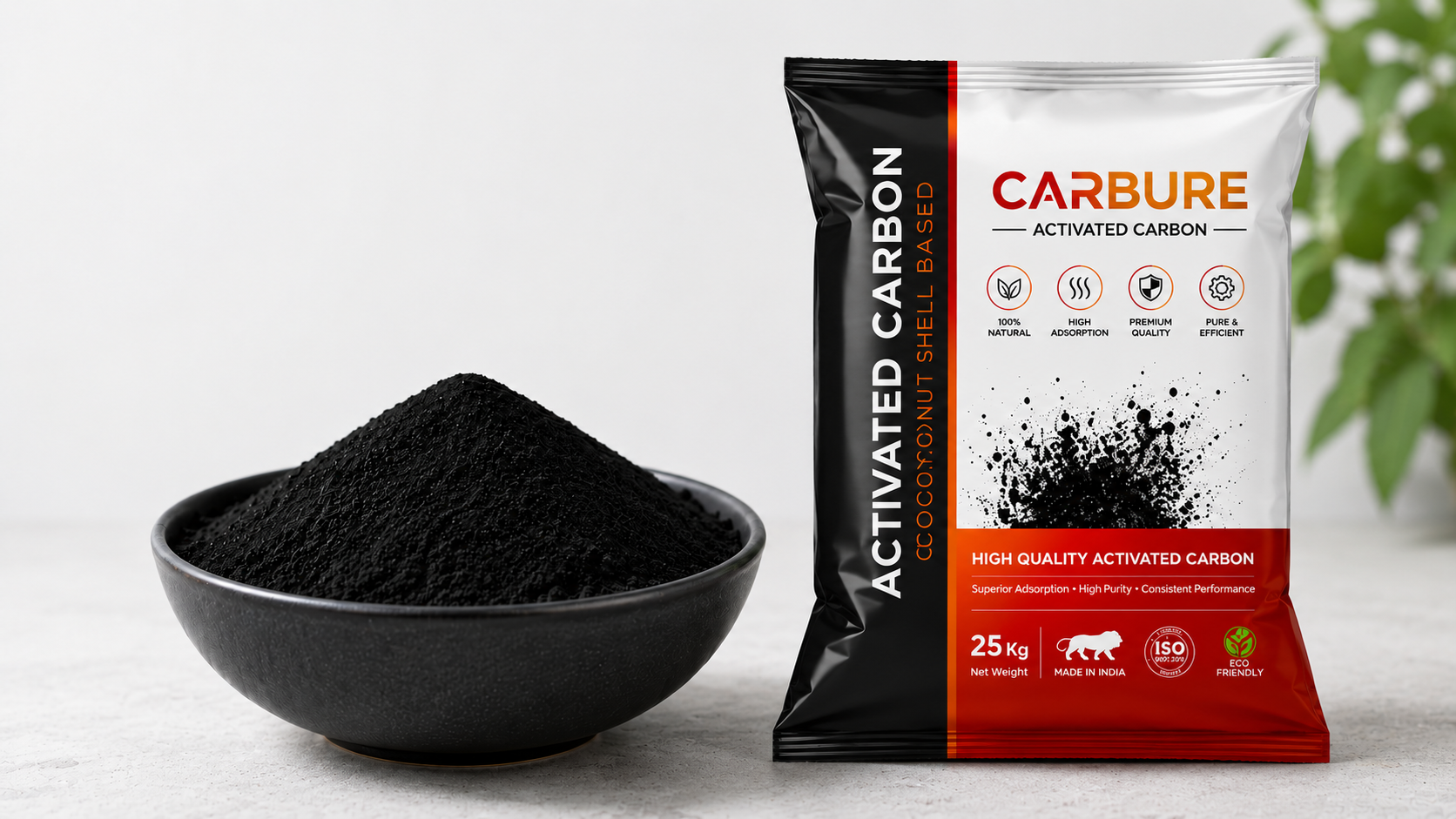
What Is an Activated Charcoal Manufacturer?
An Activated Charcoal Manufacturer produces highly porous carbon materials used for adsorption and purification in industrial, environmental, commercial, and process applications.
Activated Charcoal and Activated Carbon are terms often used interchangeably. In industrial sectors, the term Activated Carbon is more common, while Activated Charcoal may be used in both industrial and consumer markets.
A professional manufacturer controls the complete production process, including raw material selection, carbonization, activation, washing, sizing, testing, packing, and quality inspection.
Carbure Activated Carbon manufactures high-performance Steam Activated Carbon from premium Coconut Charcoal. During activation, Coconut Charcoal faces superheated steam at 1000°C, developing an advanced pore structure suitable for demanding industrial purification applications.
Why Manufacturer Quality Matters
The quality of Activated Charcoal directly affects purification performance, operating cost, filter life, contaminant removal, and overall process reliability.
Activated Charcoal from inconsistent manufacturing processes may vary in adsorption capacity, ash content, hardness, moisture level, particle size, and pore structure from one batch to another.
For industrial users, such variation can lead to inconsistent treatment results, frequent carbon replacement, higher operational costs, pressure-drop issues, and reduced purification efficiency.
A reliable Activated Charcoal Manufacturer should maintain controlled production conditions, defined product specifications, batch testing, and consistent quality across repeated supplies.
Check the Raw Material Used by the Activated Charcoal Manufacturer
Raw material is one of the most important factors influencing Activated Charcoal performance. Different raw materials develop different pore structures, hardness levels, ash characteristics, and adsorption behaviour.
Coconut Charcoal Based Activated Carbon
Coconut Charcoal is widely preferred for applications requiring high hardness, strong micropore development, low attrition, and reliable adsorption of smaller contaminant molecules.
Steam Activated Carbon manufactured from Coconut Charcoal is commonly used in water treatment, air purification, gold recovery, gas filtration, solvent recovery, and specialised industrial purification systems.
Coal Based Activated Carbon
Coal-based carbon generally develops a broader pore structure and may be suitable for applications involving a wider range of molecular sizes.
Wood Based Activated Carbon
Wood-based Activated Carbon typically develops greater mesopore and macropore volume and can be useful for decolorization and adsorption of larger molecules.
The right manufacturer should help customers select the raw material and carbon structure most suitable for the target application rather than recommending one grade for every process.
Evaluate Activated Charcoal Performance Specifications
Before selecting an Activated Charcoal Manufacturer, buyers should review the technical specifications relevant to their purification process.
- Iodine Value: Commonly used as an indicator of micropore development and adsorption capacity.
- Surface Area: Indicates the internal area available for adsorption.
- Hardness: Important for reducing carbon breakdown, fines generation, and media loss.
- Ash Content: Indicates the amount of inorganic residue present in the carbon.
- Moisture: Important for storage, handling, and usable carbon quantity.
- Particle Size: Influences pressure drop, contact time, flow performance, and filtration efficiency.
- Pore Size Distribution: Determines suitability for contaminants of different molecular sizes.
- pH: Should be compatible with the intended process or application.
The correct specification depends on the treatment objective. Higher values are not automatically better unless they match the contaminant and process conditions.
Check Certifications and Quality Control Systems
A reliable Activated Charcoal Manufacturer should operate under documented quality systems and conduct testing to verify that finished products meet the required specifications.
Quality control may include testing of iodine value, ash content, moisture, particle size, hardness, pH, adsorption characteristics, and application-specific parameters.
Buyers should also evaluate whether the manufacturer's certifications and compliance standards are suitable for their industry, country, and end-use application.
Carbure Activated Carbon follows structured quality systems and supports industrial customers with technical specifications, quality documentation, and application-specific Activated Carbon grades.
Evaluate Manufacturing and Supply Capability
Industrial customers require more than a good laboratory sample. The manufacturer must also be capable of supplying consistent product quality across commercial and bulk quantities.
Important supply factors include:
- Consistent batch-to-batch quality
- Reliable raw material sourcing
- Manufacturing capacity
- Bulk order capability
- Standard and customised grades
- Suitable packaging options
- Export documentation
- Global logistics support
- Reliable delivery schedules
A strong Activated Charcoal Manufacturer should be able to scale from samples and technical evaluation to regular bulk supply without compromising the agreed product specification.
Choose a Manufacturer That Provides Technical Support
Activated Charcoal selection should be based on the actual contaminant, treatment medium, operating conditions, contact time, process design, and required purification result.
A technically capable manufacturer can help evaluate factors such as:
- Target contaminant
- Liquid or gas phase application
- Contaminant concentration
- Required adsorption capacity
- Particle size
- Flow rate
- Contact time
- Pressure drop
- Operating temperature
- Required product purity
Technical support can help industries avoid selecting carbon solely on iodine value or price and instead choose a grade that matches the actual process requirement.
Industrial Applications of Activated Charcoal
Activated Charcoal is used across numerous industries because of its ability to adsorb organic compounds, odors, colors, gases, vapors, and contaminants.
| Liquid Phase Applications | Gas Phase Applications |
|---|---|
| Drinking water treatment | Air purification |
| Industrial water purification | VOC adsorption |
| Wastewater treatment | Odor control |
| Food and beverage purification | Industrial exhaust treatment |
| Pharmaceutical processing | Gas purification |
| Chemical purification | Solvent vapor adsorption |
| Gold recovery | Emission control systems |
Choose the Right Form of Activated Charcoal
Granular Activated Carbon
Granular Activated Carbon is commonly used in fixed-bed filters, water purification systems, process treatment vessels, and gold recovery applications.
Powdered Activated Carbon
Powdered Activated Carbon is preferred for rapid adsorption, batch treatment, decolorization, odor control, wastewater treatment, and direct dosing applications.
Pelletized Activated Carbon
Pelletized Activated Carbon is commonly used in air and gas purification systems because it provides uniform airflow, low pressure drop, mechanical stability, and reduced dust generation.
A professional Activated Charcoal Manufacturer should be able to recommend the appropriate form and grade according to the specific application.
Why Choose Carbure Activated Carbon as Your Activated Charcoal Manufacturer?
Carbure Activated Carbon is an Activated Carbon manufacturer in India supplying high-performance carbon solutions for industrial purification applications worldwide.
We manufacture Steam Activated Carbon from premium Coconut Charcoal using controlled activation technology. Coconut Charcoal faces superheated steam at 1000°C to develop the pore structure required for efficient adsorption.
Our product range supports water treatment, wastewater treatment, air purification, gold recovery, pharmaceutical purification, food and beverage processing, chemical purification, solvent recovery, VOC adsorption, odor control, and other industrial applications.
Carbure Activated Carbon supports customers with standard and application-specific grades, technical specifications, quality control, bulk supply, and product selection assistance.
FAQs
Choose an Activated Charcoal Manufacturer based on raw material quality, activation method, adsorption performance, product consistency, quality testing, certifications, technical support, manufacturing capability, and reliable bulk supply.
Raw material influences pore structure, hardness, ash content, adsorption characteristics, durability, and suitability for different liquid and gas purification applications.
Important specifications can include iodine value, particle size, hardness, ash content, moisture, pH, surface area, and pore size distribution, depending on the intended application.
Coconut Charcoal based Activated Carbon is preferred for many applications because of its high hardness, strong micropore structure, low attrition, and reliable adsorption performance.
Yes. Depending on manufacturing capability, Activated Charcoal can be supplied in application-specific grades based on particle size, adsorption characteristics, ash level, hardness, moisture, pH, and other technical requirements.
Looking for a Reliable Activated Charcoal Manufacturer?
Carbure Activated Carbon manufactures high-performance Activated Carbon from Coconut Charcoal for water treatment, wastewater treatment, air purification, gold recovery, pharmaceutical processing, food and beverage purification, chemical treatment, solvent recovery, and industrial filtration applications.
Contact Carbure Activated Carbon for suitable grades, product specifications, technical support, samples, and bulk Activated Carbon supply.
