
Activated Carbon Manufacturers India: Products, Applications & Selection Guide
Introduction
Activated Carbon Manufacturers India play an important role in supplying adsorption materials for industrial water treatment, air purification, chemical processing, food and beverage production, pharmaceutical applications, gold recovery, and other purification requirements.
Activated Carbon is a highly porous adsorbent manufactured from suitable carbon-rich raw materials. Its developed internal pore structure provides a large surface area where selected dissolved or gaseous contaminants can be retained through adsorption.
India has an established activated carbon manufacturing industry, with coconut shell-based Activated Carbon forming an important product category. Coconut shells provide a renewable carbon-rich raw material that can be converted into Activated Carbon through controlled carbonization and activation processes.
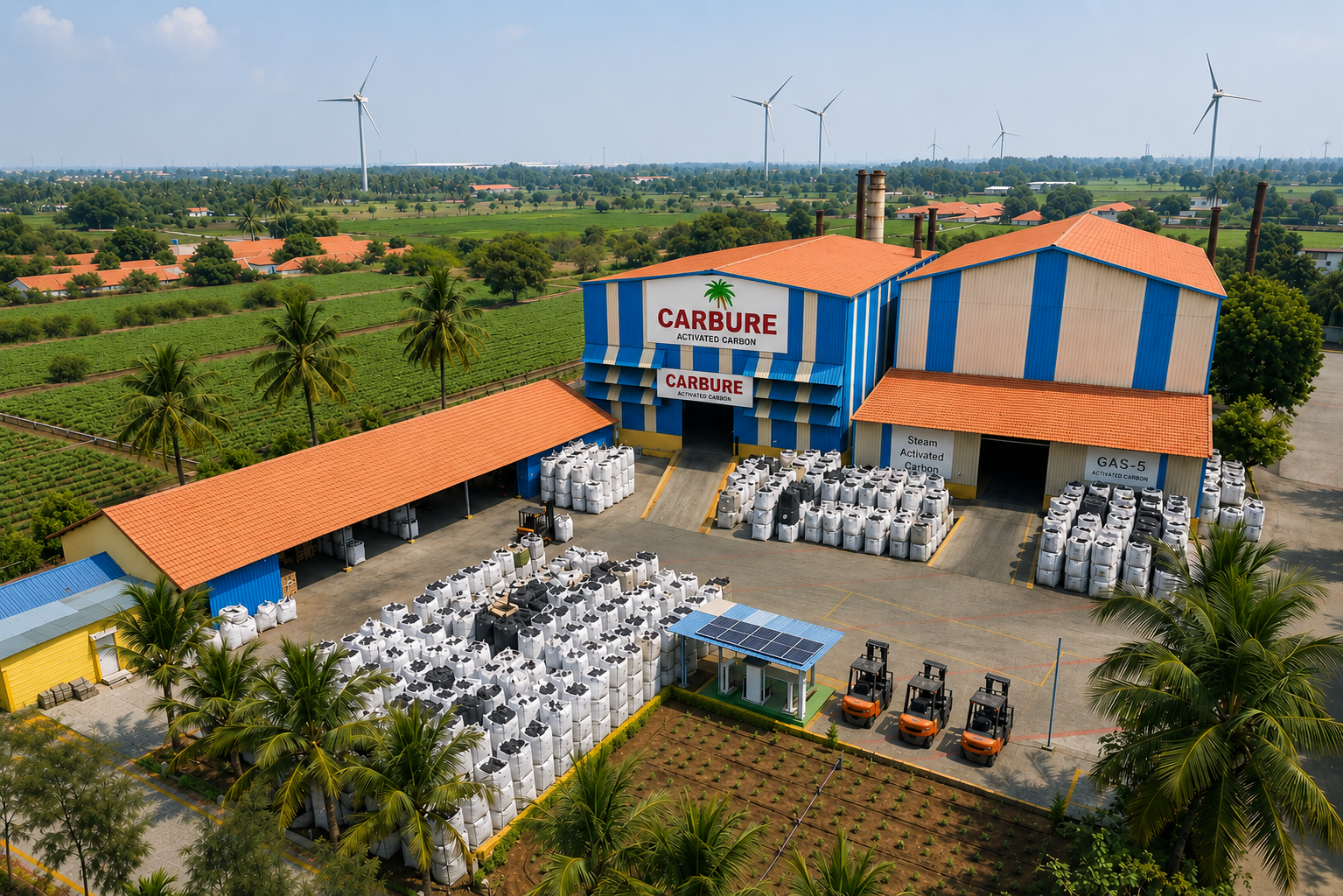
Carbure Activated Carbon Pvt. Ltd. is an Activated Carbon Manufacturer in India specializing in coconut shell-based Steam Activated Carbon for industrial adsorption and purification applications.
For industrial buyers searching for Activated Carbon Manufacturers India, selecting a suitable manufacturer involves more than comparing prices. Product specifications, adsorption performance, raw material quality, manufacturing consistency, technical support, and application suitability should all be considered.
Who Are Activated Carbon Manufacturers in India?
Activated Carbon Manufacturers in India are companies involved in producing porous carbon adsorbents from suitable carbonaceous raw materials through controlled manufacturing processes.
Activated Carbon can be manufactured from coconut shells, coal, wood, and other suitable carbon-rich materials. The choice of raw material and activation process influences the final carbon's pore structure, adsorption characteristics, ash content, hardness, and suitability for different industrial applications.
Manufacturers may supply several forms of Activated Carbon, including Granular Activated Carbon (GAC), Powdered Activated Carbon (PAC), and Pelletized Activated Carbon.
These products are used in different treatment systems according to their particle size, mechanical properties, pore structure, and adsorption requirements.
Industrial customers should distinguish between a manufacturer, distributor, trader, and exporter when evaluating suppliers. A manufacturer is directly involved in producing or processing the material, while other businesses may source finished products from external facilities.
Understanding the supplier's manufacturing capabilities, quality control procedures, available grades, and technical documentation can help buyers select an appropriate source for their requirements.
Activated Carbon Manufacturing Process in India
The manufacturing process used by Activated Carbon Manufacturers in India depends on the selected raw material, activation technology, desired pore structure, and final product specifications.
Step 1 - Raw Material Selection
Manufacturing begins with selecting suitable carbon-rich raw materials. Coconut shells are commonly used for producing activated carbon grades requiring developed microporosity and mechanical strength.
Raw material quality can influence carbon yield, ash content, pore development, and final product consistency.
Step 2 - Carbonization
During carbonization, the raw material is heated under controlled conditions with limited oxygen availability. Volatile substances are released, leaving behind a carbon-rich material.
In coconut shell-based production, the carbonized material is commonly referred to as Coconut Charcoal.
Step 3 - Steam Activation
The Coconut Charcoal undergoes physical activation using steam at elevated temperatures. At Carbure Activated Carbon, the material is exposed to superheated steam at 1000°C to develop its porous internal structure.
Controlled activation creates and enlarges pores within the carbon, increasing the surface available for adsorption.
Step 4 - Cooling and Processing
After activation, the carbon is cooled under controlled conditions and processed according to the required product specifications.
Depending on the application, the carbon may undergo crushing, grinding, screening, or other suitable processing operations.
Step 5 - Particle Size Classification
The Activated Carbon is classified into appropriate particle size ranges for different industrial applications.
Granular grades are commonly used in fixed-bed filtration systems, while powdered grades may be used in batch treatment or dosing processes.
Step 6 - Quality Testing
Finished Activated Carbon is evaluated using relevant physical and adsorption quality parameters. These may include iodine number, moisture content, ash content, particle size distribution, hardness, bulk density, and application-specific adsorption performance.
Step 7 - Packaging and Supply
The tested material is packaged according to the product grade and customer requirements. Suitable packaging and storage conditions help protect the carbon from moisture and unwanted contamination during transportation.
For industrial customers, consistent batch quality and accurate product specifications are important factors when selecting Activated Carbon Manufacturers in India.
Role of Activated Carbon Manufacturers in Industrial Purification
Activated Carbon Manufacturers in India support a wide range of industrial purification processes by supplying carbon adsorbents designed for specific treatment requirements.
Activated Carbon functions through adsorption, a surface phenomenon in which suitable molecules accumulate on the internal surfaces of a porous solid.
Its adsorption performance depends on pore size distribution, surface chemistry, contaminant characteristics, contact time, temperature, and other operating conditions.
Different industrial applications require different carbon properties. A grade selected for drinking water treatment may not provide the same performance in solvent recovery, gold adsorption, oil decolorization, or gas purification.
For this reason, manufacturers should support product selection through appropriate specifications and, where necessary, representative application testing.
Manufacturing consistency is also important. Variations in raw materials, activation conditions, particle size, or physical properties can influence the performance of Activated Carbon in industrial treatment systems.
A suitable manufacturer should therefore be evaluated according to the consistency of its products and their compatibility with the customer's actual operating requirements.
Key Benefits of Choosing Activated Carbon Manufacturers in India
Working with an appropriate Activated Carbon Manufacturer in India can provide several advantages for industrial buyers when the manufacturer has the required product capabilities and quality systems.
- Access to coconut shell-based Activated Carbon grades for industrial applications.
- Availability of Granular Activated Carbon and Powdered Activated Carbon for different treatment systems.
- Application-based selection of adsorption and physical properties.
- Technical specifications for evaluating product suitability.
- Opportunities to compare carbon grades using representative testing.
- Support for bulk industrial procurement requirements.
- Better understanding of raw material selection and manufacturing processes.
- Ability to review particle size, hardness, moisture, ash, and adsorption characteristics.
- Potential for consistent supply when supported by suitable production and inventory arrangements.
- Direct technical communication regarding carbon grades and application requirements.
These benefits depend on the capabilities of the individual manufacturer. Buyers should verify product specifications, manufacturing arrangements, quality documentation, and supply terms before placing orders.
Industrial Applications Served by Activated Carbon Manufacturers in India
Activated Carbon is used across several industries where adsorption is required to reduce selected contaminants from liquids or gases.
Water and Wastewater Treatment
Activated Carbon is widely used in water treatment systems to reduce residual chlorine, selected dissolved organic compounds, taste, odor, and certain color-causing substances.
Granular Activated Carbon is commonly installed in fixed-bed filtration units, while Powdered Activated Carbon may be used in suitable dosing and contact treatment processes.
Air and Gas Purification
Activated Carbon is used in appropriately designed air and gas treatment systems to adsorb selected volatile organic compounds, odor-causing substances, and other suitable gaseous contaminants.
Carbon grade selection depends on the gas composition, contaminant concentration, humidity, contact conditions, and treatment requirements.
Gold Recovery
Coconut shell-based Granular Activated Carbon is used in Carbon-in-Pulp (CIP) and Carbon-in-Leach (CIL) gold recovery circuits to adsorb dissolved gold-cyanide complexes.
Important carbon characteristics include gold adsorption activity, loading capacity, mechanical hardness, particle size, and resistance to attrition.
Food and Beverage Processing
Suitable Activated Carbon grades may be used in food and beverage processing for selected color, taste, odor, and organic impurity reduction.
Grades must be evaluated against applicable food-processing requirements and the specifications of the intended application.
Pharmaceutical and Chemical Processing
Activated Carbon can support selected purification, decolorization, and impurity removal processes in pharmaceutical and chemical manufacturing.
The required carbon purity, adsorption characteristics, and quality documentation depend on the process and final product specifications.
Industrial Oil and Liquid Purification
Activated Carbon may be used in selected industrial liquid and oil purification processes to adsorb color-causing compounds, odor-producing substances, and other suitable dissolved organic impurities.
Carbon performance must be evaluated using the actual liquid and target contaminants.
Solvent Recovery
Activated Carbon is used in engineered solvent recovery systems where suitable volatile organic compounds are adsorbed from gas streams.
System design, carbon compatibility, adsorption capacity, and regeneration requirements are important considerations.
Quality Factors When Selecting Activated Carbon Manufacturers India
Industrial buyers evaluating Activated Carbon Manufacturers in India should consider both the technical characteristics of the carbon and the supplier's ability to provide consistent products.
- Raw material quality: Understand the source and characteristics of the carbonaceous raw material.
- Activation process: Review whether the manufacturing process produces the pore structure required for the intended application.
- Iodine number: A useful indicator of adsorption characteristics for certain applications, but not a universal measure of performance.
- Surface area: Evaluate the available internal surface area together with pore accessibility and contaminant characteristics.
- Pore size distribution: Confirm suitability for the molecular size and chemistry of the target contaminants.
- Particle size: Select a size distribution compatible with filtration, dosing, hydraulic, or handling requirements.
- Mechanical hardness: Important for granular grades exposed to handling, backwashing, agitation, or repeated use.
- Ash content: Review inorganic residue levels according to application requirements.
- Moisture content: Consider storage conditions and the moisture specification of the carbon.
- Bulk density: Important for packaging, transport, bed volume, and system design.
- Quality consistency: Evaluate batch testing and product specification control.
- Application testing: Use representative trials to verify performance under actual treatment conditions.
The most appropriate Activated Carbon grade is not necessarily the product with the highest iodine value or surface area. The selected carbon must perform effectively in the intended industrial process.
Coconut Shell Activated Carbon Manufacturing in India
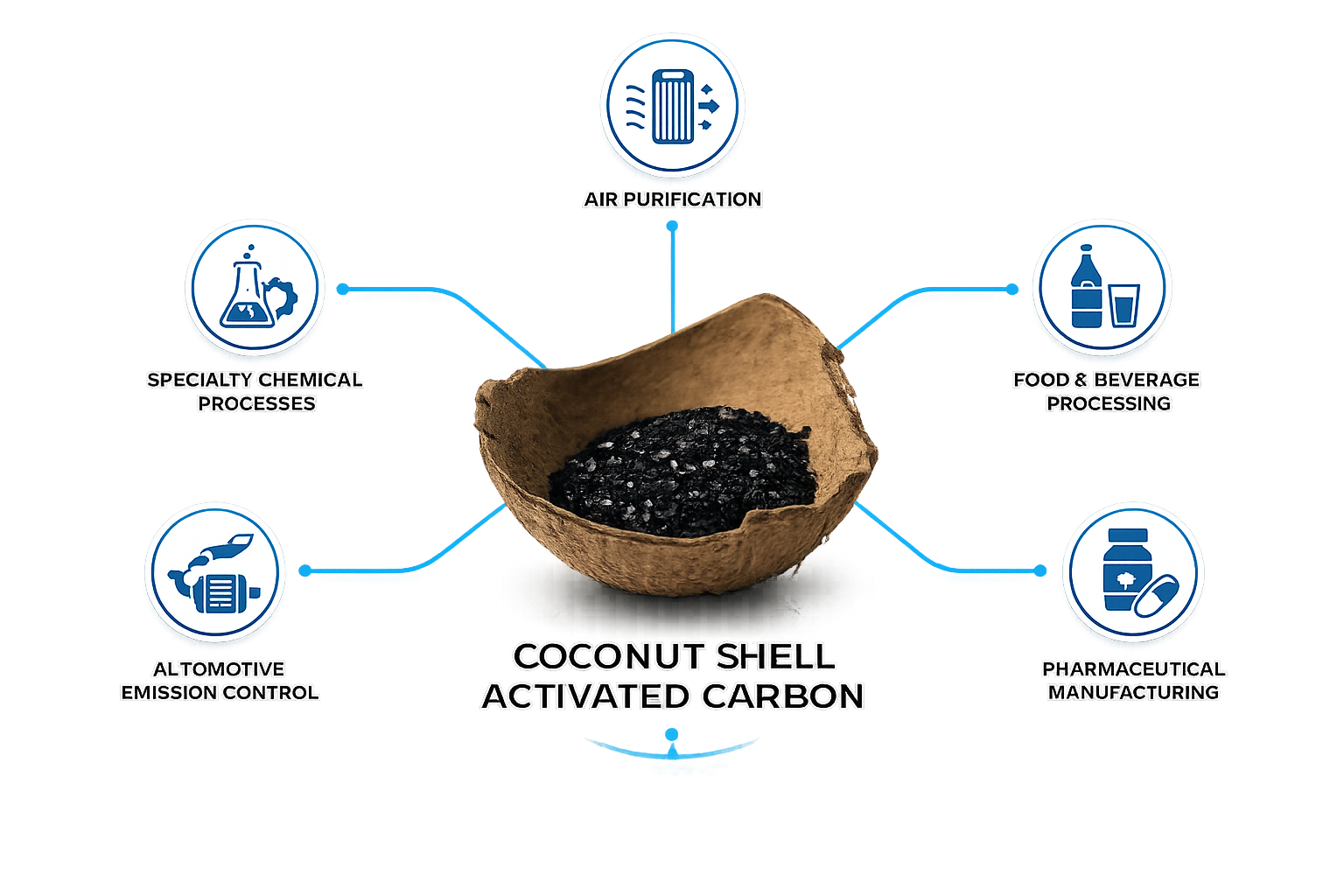
Coconut Shell Activated Carbon is an important product category supplied by Activated Carbon Manufacturers in India. Coconut shells provide a carbon-rich raw material suitable for manufacturing several industrial adsorption grades.
During manufacturing, coconut shells are converted into Coconut Charcoal through carbonization. The Coconut Charcoal is then activated under controlled conditions to develop the internal pore structure required for adsorption.
At Carbure Activated Carbon, physical activation involves exposing Coconut Charcoal to superheated steam at 1000°C.
The resulting Steam Activated Carbon develops a network of pores that provides adsorption surfaces for suitable molecules. Depending on the manufacturing conditions and carbon grade, activated carbon surface areas may fall within a broad range such as 600–2000 m²/g.
Coconut shell-based Activated Carbon can offer useful mechanical hardness and developed microporosity, making suitable grades relevant to several water, gas, and industrial adsorption applications.
However, coconut shell carbon is not automatically the best choice for every contaminant. Larger molecules or specialized treatment requirements may require different pore structures or alternative carbon grades.
Manufacturers should therefore evaluate the required adsorption performance, particle size, purity, and mechanical characteristics before recommending a product.
Powdered vs. Granular Activated Carbon from Manufacturers in India
Activated Carbon Manufacturers in India supply different physical forms of carbon to meet specific industrial treatment requirements. Two commonly used forms are Powdered Activated Carbon (PAC) and Granular Activated Carbon (GAC).
| Powdered Activated Carbon (PAC) | Granular Activated Carbon (GAC) |
|---|---|
| Fine carbon particles commonly used in dosing and contact treatment processes. | Larger carbon particles commonly used in fixed-bed filtration systems. |
| Can be dispersed into suitable liquid streams for batch adsorption treatment. | Can be retained within appropriately designed filtration vessels. |
| Provides close contact between carbon particles and the treated liquid. | Performance depends on bed design, flow distribution, and contact time. |
| Requires suitable clarification or filtration to remove spent carbon. | Requires appropriate media retention, backwashing, and monitoring. |
| Carbon dosage can be adjusted according to treatment requirements. | Carbon replacement or regeneration depends on loading and performance. |
| Commonly evaluated for decolorization, wastewater treatment, and selected liquid purification processes. | Commonly evaluated for water filtration, gas purification, and other fixed-bed adsorption applications. |
| Batch / Dosing Treatment | Fixed-Bed / Continuous Treatment |
Neither Powdered Activated Carbon nor Granular Activated Carbon is universally superior. Selection depends on the contaminant characteristics, process design, adsorption performance, operating conditions, and carbon separation requirements.
Why Choose Carbure Among Activated Carbon Manufacturers in India?
Carbure Activated Carbon Pvt. Ltd. is an Activated Carbon Manufacturer in India specializing in coconut shell-based Activated Carbon for industrial purification and adsorption applications.
Our Steam Activated Carbon is manufactured using premium Coconut Charcoal and controlled steam activation technology. During manufacturing, Coconut Charcoal is exposed to superheated steam at 1000°C, developing a porous internal structure suitable for selected adsorption applications.
Carbure Activated Carbon supplies carbon solutions for industrial water purification, wastewater treatment, air and gas adsorption, chemical processing, liquid purification, and gold recovery applications.
Our gold recovery product range includes GOLD CARB 60 and GOLD CARBURE 55. Product selection should be based on current technical specifications and application-specific testing.
As an Activated Carbon Manufacturer in India, Carbure focuses on helping industrial customers evaluate carbon grades according to their actual process requirements.
Important considerations include adsorption performance, pore structure, particle size distribution, mechanical hardness, ash content, moisture, and compatibility with the intended treatment system.
Customers looking for Activated Carbon Manufacturers India can contact Carbure Activated Carbon to discuss product grades, technical specifications, bulk requirements, and supply arrangements for domestic and international applications.
Frequently Asked Questions - Activated Carbon Manufacturers India
Activated Carbon Manufacturers in India are companies that produce porous carbon adsorbents from suitable carbon-rich raw materials. These manufacturers may supply Granular Activated Carbon, Powdered Activated Carbon, and other grades for industrial water treatment, air purification, chemical processing, gold recovery, and related applications.
Activated Carbon Manufacturers in India produce several forms of Activated Carbon, including Granular Activated Carbon (GAC), Powdered Activated Carbon (PAC), and Pelletized Activated Carbon. Products may be manufactured from coconut shells, coal, wood, or other suitable carbonaceous materials depending on the intended application.
Coconut shells are a carbon-rich raw material suitable for producing Activated Carbon. Properly manufactured coconut shell-based grades can provide developed microporosity and mechanical hardness for selected industrial adsorption applications. Actual performance depends on the carbon grade and treatment requirements.
Select a manufacturer based on product specifications, raw material quality, manufacturing process, adsorption performance, particle size, hardness, quality consistency, technical documentation, and suitability for your application. Representative testing is recommended for demanding industrial processes.
Activated Carbon is used in water and wastewater treatment, air and gas purification, gold recovery, food and beverage processing, pharmaceutical manufacturing, chemical processing, solvent recovery, and selected industrial liquid purification applications.
Yes. Carbure Activated Carbon Pvt. Ltd. is an Activated Carbon Manufacturer in India producing coconut shell-based Steam Activated Carbon for industrial adsorption and purification applications. Customers can contact Carbure to discuss suitable grades, technical specifications, application requirements, and bulk supply.
Looking for Activated Carbon Manufacturers India?
Carbure Activated Carbon is an Activated Carbon Manufacturer in India supplying coconut shell-based Steam Activated Carbon for industrial water treatment, wastewater purification, air and gas adsorption, chemical processing, gold recovery, and other specialized purification applications.
Our Activated Carbon products can be evaluated according to adsorption performance, pore structure, particle size, mechanical hardness, moisture, ash content, and application-specific requirements.
Contact Carbure Activated Carbon to discuss Granular Activated Carbon, Powdered Activated Carbon, technical specifications, suitable product grades, bulk orders, and supply requirements across India and international markets.
