
Activated Carbon Manufacturer in India: Products, Manufacturing Process, Applications & Buyer’s Guide
Activated Carbon Manufacturer in India: An Overview
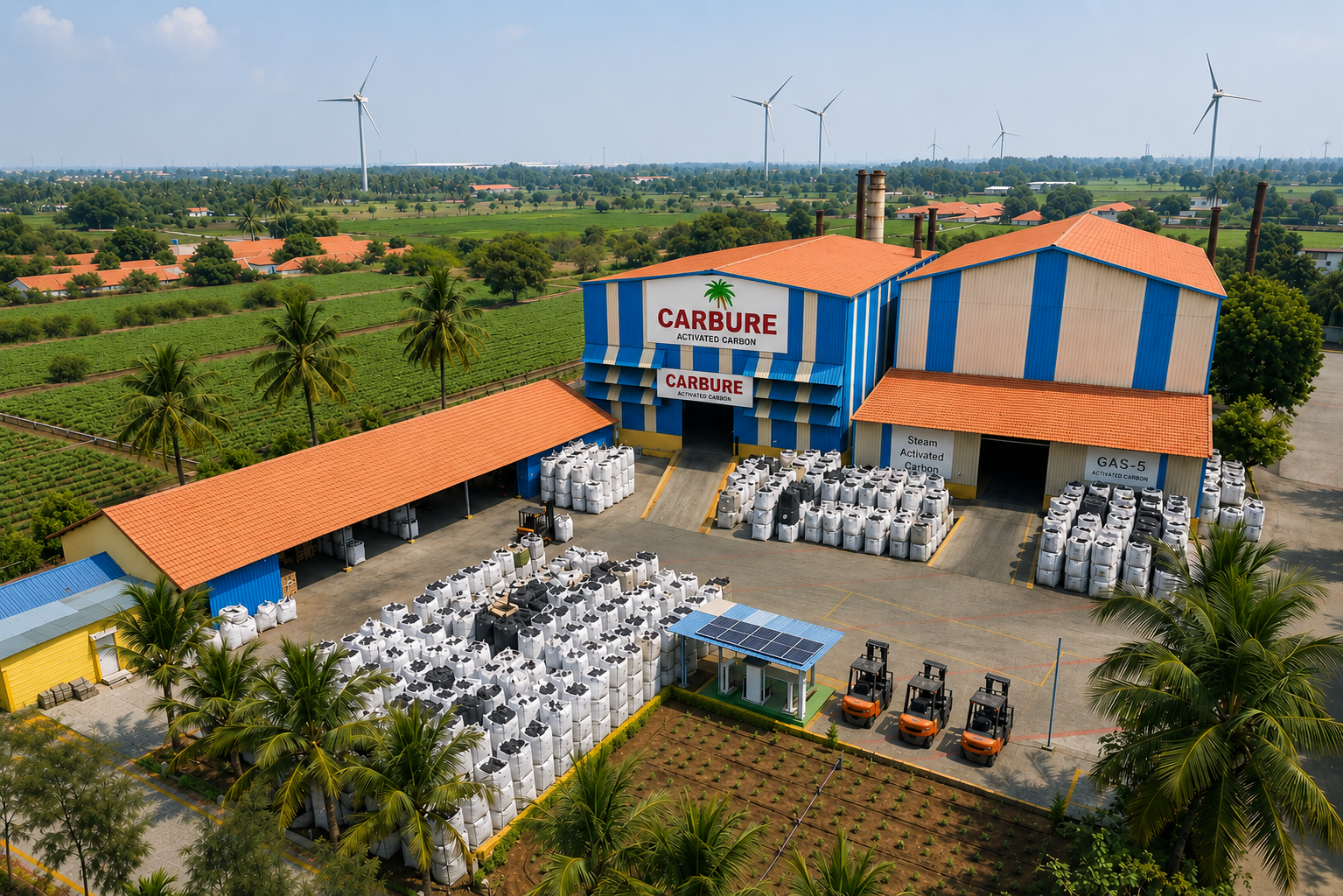
Choosing an Activated Carbon Manufacturer in India requires evaluating product quality, technical specifications, manufacturing consistency and application suitability not price alone.
Carbure Activated Carbon Pvt. Ltd. manufactures Steam Activated Carbon from Coconut Charcoal for industrial purification and adsorption requirements. This guide explains products, manufacturing processes, applications and purchasing considerations.
Activated Carbon Manufacturing Process in India
Activated carbon manufacturing involves controlled raw material preparation, activation, sizing and quality assessment.
1. Coconut Charcoal Selection
Suitable Coconut Charcoal is selected with attention to feedstock consistency and physical characteristics.
2. Steam Activation
At Carbure, Coconut Charcoal faces superheated steam at 1000°C. This process develops an internal pore structure that supports adsorption.
3. Sizing and Processing
The activated material is sized for the intended product form and treatment equipment.
4. Optional Post-Treatment
Specialty requirements may call for additional treatments, such as acid washing to reduce selected acid-soluble mineral residues.
5. Testing and Packaging
Grades are evaluated against agreed specifications before packing and dispatch.
Types of Activated Carbon Products
Granular Activated Carbon (GAC)
Used in selected fixed-bed filtration and continuous treatment systems. Particle size, hardness and pressure drop matter.
Powdered Activated Carbon (PAC)
Fine carbon suitable for certain dosing and batch purification processes, followed by appropriate separation.
Pelletized Activated Carbon
Considered for suitable gas-phase adsorption systems where bed hydraulics and particle strength are relevant.
Gold Recovery Activated Carbon
Application-specific grades may be evaluated for gold adsorption circuits, with emphasis on adsorption characteristics and mechanical durability.
Acid-Washed Activated Carbon
Selected where reduced acid-soluble mineral residues or extractables are important. Read our acid-washed activated carbon guide.
Industrial Applications of Activated Carbon
Different grades of activated carbon are selected for different industrial treatment objectives.
| Industry | Typical Application |
|---|---|
| Water Treatment | Reduction of selected dissolved organic compounds, taste and odour substances; chlorine removal involves surface reactions. |
| Industrial Wastewater | Polishing of selected residual organic contaminants. |
| Air and Gas Purification | Adsorption of suitable vapours and gas contaminants. |
| Gold Recovery | Application-specific carbon used in suitable adsorption circuits. |
| Food and Beverage | Selected decolourisation and purification processes, subject to grade requirements. |
| Chemical and Pharmaceutical | Selected purification processes where technical and regulatory requirements are met. |
Factors Affecting Activated Carbon Performance
- Target contaminant: Chemical properties, molecular size and concentration.
- Pore structure: Accessibility of adsorption sites.
- Operating conditions: Temperature, pH, competing compounds and moisture.
- Contact time: Flow rate, bed depth and treatment configuration.
- Carbon condition: Fouling, exhaustion and particle attrition.
Activated carbon is not suitable for every contaminant. Testing should confirm the treatment objective.
Why Work with an Activated Carbon Manufacturer in India?
Direct manufacturer discussions can help buyers evaluate grade specifications, product forms, documentation and supply planning.
- Discuss application-specific carbon grades and performance.
- Review quality control and technical specifications.
- Coordinate bulk requirements and repeat supply.
- Clarify packaging, delivery terms and export documentation.
Manufacturing location alone does not establish quality; verify the proposed grade and supplier capability.
Technical Specifications Buyers Should Review
| Parameter | Why It Matters |
|---|---|
| Iodine Value | Indicator of micropore development, not universal adsorption performance. |
| Particle Size | Influences flow, contact and pressure drop. |
| Hardness | Relates to abrasion resistance and fines generation. |
| Moisture | Relevant to storage, handling and product specifications. |
| Ash / Extractables | Important for selected sensitive purification applications. |
| pH | Relevant to compatibility and specification control. |
| Application Testing | Verifies performance for actual contaminants and operating conditions. |
Buyer’s Guide: Choosing the Right Manufacturer
1. Define the Treatment Objective
Identify the application, target contaminants and desired treated-stream quality.
2. Select the Product Form
Choose granular, powdered, pelletized or specialty carbon according to equipment and process needs.
3. Check Specifications
Review particle size, iodine value, hardness, ash, moisture and relevant grade-specific properties.
4. Review Manufacturing Consistency
Ask about feedstock controls, activation, sampling and traceability.
5. Request Samples or Trials
Conduct laboratory or pilot testing when performance is critical.
6. Confirm Commercial Requirements
Check order quantity, packaging, lead times, shipping terms and export documents.
7. Evaluate Ongoing Support
Consider responsiveness, technical assistance and repeat-order consistency.
Why Coconut Charcoal for Steam Activated Carbon?

Coconut Charcoal is a widely used raw material for producing activated carbon with developed microporosity and useful physical strength.
At Carbure, Coconut Charcoal faces superheated steam at 1000°C during controlled activation. This process develops a highly porous internal structure that supports effective adsorption of contaminants in various industrial purification applications.
Why Choose Carbure Activated Carbon Pvt. Ltd.?
Carbure Activated Carbon Pvt. Ltd. manufactures Coconut Charcoal-based Steam Activated Carbon for industrial adsorption and purification applications.
For buyers seeking an Activated Carbon Manufacturer in India, Carbure can discuss intended applications, technical requirements, available grades, bulk orders and export enquiries. Confirm product-specific specifications and suitability before ordering.
Frequently Asked Questions – Activated Carbon Manufacturer in India
Manufacturers may offer granular, powdered, pelletized and specialty grades. Availability and specifications vary.
Coconut Charcoal is activated under controlled conditions to develop pores. At Carbure, it faces superheated steam at 1000°C.
Granular carbon is commonly used in fixed-bed filters; powdered carbon can suit dosing or batch treatment. Selection depends on water quality and process design.
GAC consists of larger particles commonly used in beds; PAC uses fine particles in suitable dosing or batch processes.
No. Consider target contaminants, pore structure, particle size, hardness, ash and application testing.
Review specifications, test documentation, packaging, lead time, shipping terms and destination requirements.
Looking for an Activated Carbon Manufacturer in India?
Contact Carbure Activated Carbon Pvt. Ltd. to discuss Granular Activated Carbon, Powdered Activated Carbon, coconut charcoal-based Steam Activated Carbon, specialty requirements, technical specifications, bulk orders and export enquiries.
