
How to Select the Right Activated Carbon Grade for Water Treatment
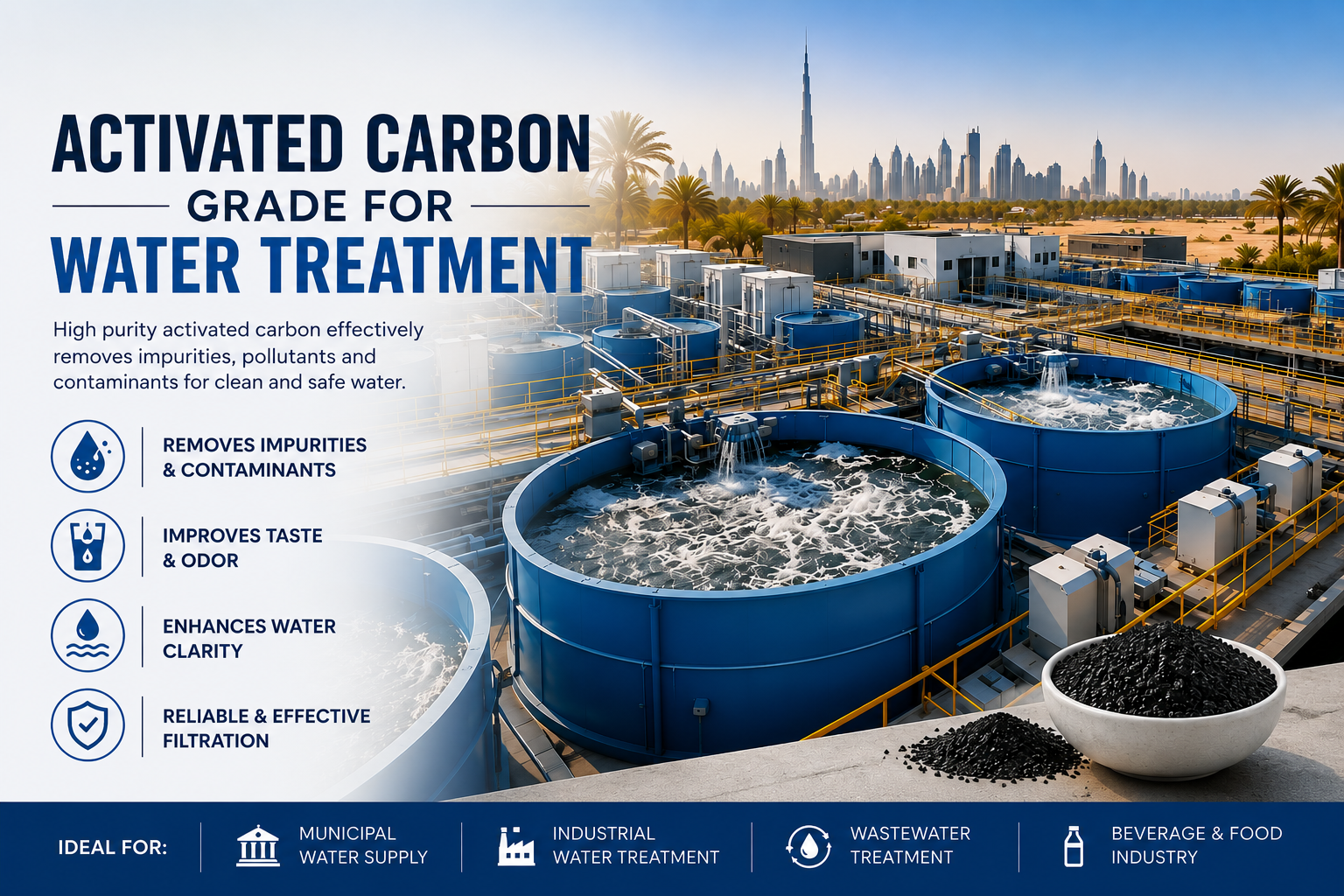
Why Activated Carbon Grade Selection Matters in Water Treatment
Selecting the right Activated Carbon grade for water treatment is important because every water source contains different contaminants, organic compounds, odors, colors, chlorine levels, and dissolved impurities. A carbon grade that works well for one application may not deliver the same performance in another system.
The right grade of Activated Carbon improves adsorption efficiency, filtration performance, service life, flow rate, and overall purification results. Factors such as raw material, particle size, iodine value, pore structure, ash content, hardness, and moisture level all influence the performance of the carbon in water treatment systems.
Carbure Activated Carbon manufactures high-performance Steam Activated Carbon from Coconut Charcoal using superheated steam activation at 1000°C. Our grades are engineered for municipal water treatment, industrial wastewater purification, process water treatment, drinking water filtration, and effluent treatment applications.
Key Factors to Consider When Selecting Activated Carbon Grade
1. Contaminant Type
The first step is to understand what needs to be removed from the water. Activated Carbon is commonly used to remove chlorine, odor, color, organic compounds, VOCs, pesticides, taste impurities, and industrial contaminants.
Different contaminants require different pore structures. Smaller molecules are adsorbed more effectively by micropores, while larger organic compounds require mesopores and macropores for better diffusion and adsorption.
2. Particle Size
Particle size plays an important role in contact time, pressure drop, flow rate, and adsorption speed. Powdered Activated Carbon is suitable for rapid treatment, while Granular Activated Carbon is preferred for fixed-bed filters and continuous water treatment systems.
The correct particle size ensures proper filtration performance without excessive pressure drop or poor contact between water and carbon.
3. Iodine Value
Iodine value indicates the micropore content and adsorption capacity of Activated Carbon. Higher iodine value generally means higher surface area and better adsorption of low molecular weight contaminants.
For water treatment, iodine value is one of the key indicators used to evaluate carbon performance, especially for organic contaminant removal.
4. Ash Content and Purity
Low ash content is important for water purification applications because excess inorganic matter can affect water quality and filtration performance. High-purity carbon is preferred for drinking water, process water, and sensitive industrial applications.
Carbure Activated Carbon focuses on consistent quality and controlled ash levels to support reliable purification performance.
Common Activated Carbon Grades for Water Treatment
Granular Activated Carbon
Granular Activated Carbon is widely used in fixed-bed filters, pressure filters, municipal water treatment systems, and industrial process water purification. It offers excellent flow characteristics, good mechanical strength, and long service life.
Powdered Activated Carbon
Powdered Activated Carbon is commonly used for rapid contaminant removal, color reduction, odor control, taste improvement, and emergency treatment applications. It provides fast adsorption because of its fine particle size and high surface contact area.
Steam Activated Carbon
Steam Activated Carbon made from Coconut Charcoal is preferred for many water treatment applications due to its hardness, developed pore structure, low impurity level, and strong adsorption efficiency. Superheated steam activation at 1000°C creates a highly porous structure suitable for demanding purification requirements.
How Activated Carbon Performance is Evaluated
The performance of Activated Carbon in water treatment depends on several technical parameters. Before selecting a grade, industries should evaluate the water quality, target contaminants, required flow rate, filter design, contact time, and treatment objective.
- Iodine Value: Indicates micropore volume and adsorption capacity.
- Particle Size: Influences flow rate, pressure drop, and contact efficiency.
- Hardness: Ensures durability during backwashing and continuous operation.
- Ash Content: Affects purity and suitability for sensitive applications.
- Moisture Content: Impacts handling, storage, and usable carbon strength.
- Surface Area: Determines the availability of adsorption sites.
- Pore Distribution: Controls adsorption of different molecular sizes.
Carbure Activated Carbon supports industries with suitable grade selection based on application requirement, water quality, and purification target.
Quality Factors to Check Before Selection
Technical Parameters
- Iodine value
- Particle size
- Surface area
- Pore size distribution
Performance Parameters
- Hardness and durability
- Low ash content
- Moisture control
- Consistent adsorption efficiency
Before selecting an Activated Carbon grade for water treatment, industries should evaluate both technical and performance parameters. The right grade helps improve contaminant removal, filter life, flow performance, and long-term purification reliability.
FAQs
Carbure Activated Carbon recommends selecting the grade based on contaminant type, water quality, particle size, iodine value, ash content, hardness, flow rate, contact time, and system design.
Steam Activated Carbon made from Coconut Charcoal is widely preferred for water treatment because of its developed pore structure, high hardness, good adsorption efficiency, and reliable purification performance.
Iodine value indicates the micropore content and adsorption capacity of Activated Carbon. A higher iodine value usually means better adsorption of smaller organic molecules and dissolved impurities.
Powdered Activated Carbon is suitable for fast adsorption and batch treatment, while Granular Activated Carbon is better for fixed-bed filters, continuous operation, and long-term water purification systems.
Need the Right Activated Carbon Grade for Water Treatment?
Carbure Activated Carbon manufactures Steam Activated Carbon from Coconut Charcoal using superheated steam activation at 1000°C. Our products are designed for water treatment, wastewater treatment, process water purification, odor removal, color reduction, and industrial filtration applications.
Contact Carbure Activated Carbon today for custom grades, bulk supply, and technical support.
